Trichology Fundamentals
A lecture on trichology fundamentals: hair and scalp structure, distinguishing telogen effluvium from androgenetic alopecia, the hair growth cycle, and trichoscopy camera imagery.
Result and process
About the course
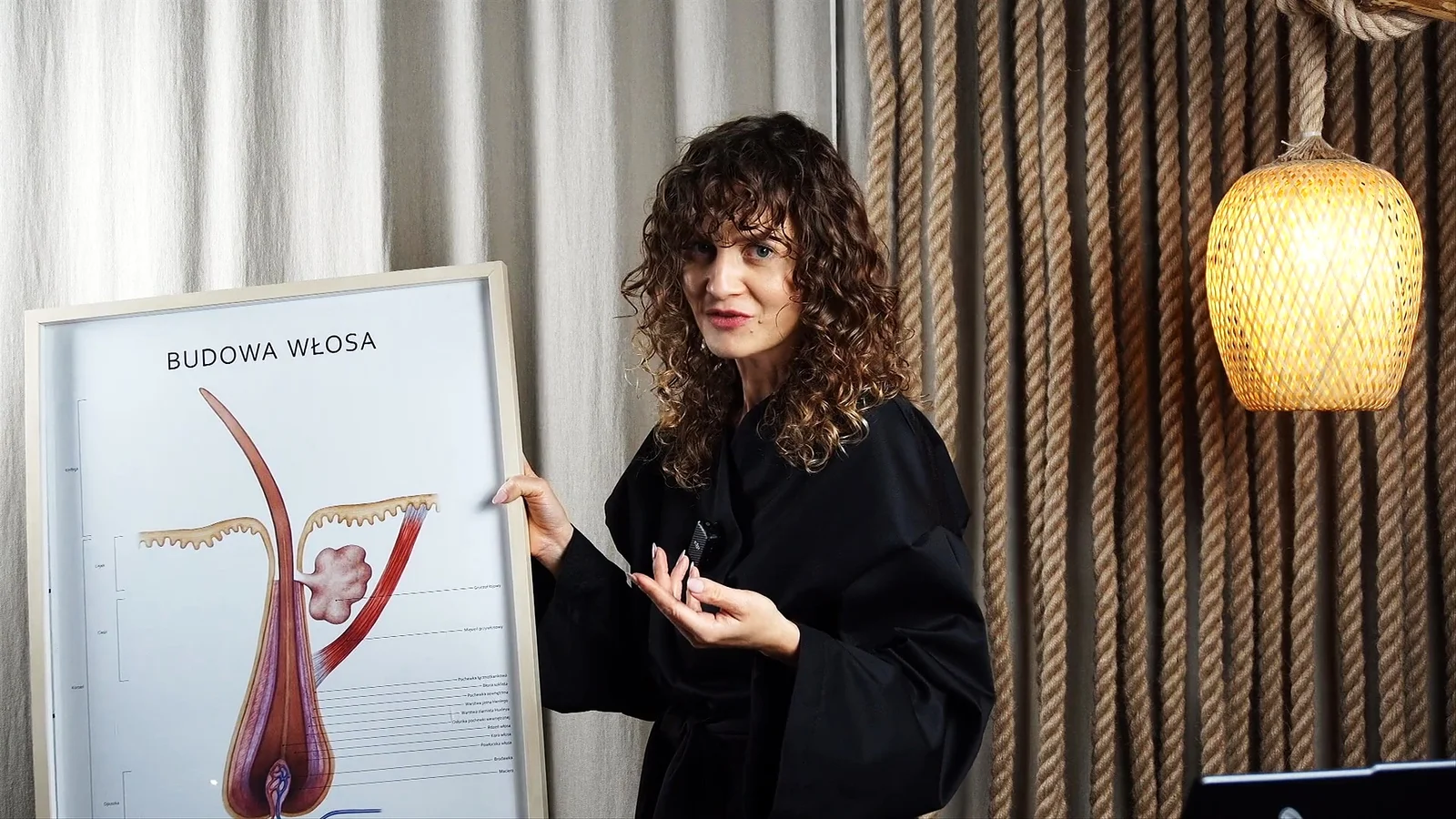
Trichology Fundamentals is a lecture by Magdalena Koc on what happens in the scalp and hair follicle before a hairdresser even picks up the scissors. The course organizes hair structure, scalp structure, types of hair loss, and the hair growth cycle - the knowledge that underpins every trichology-related decision behind the chair.
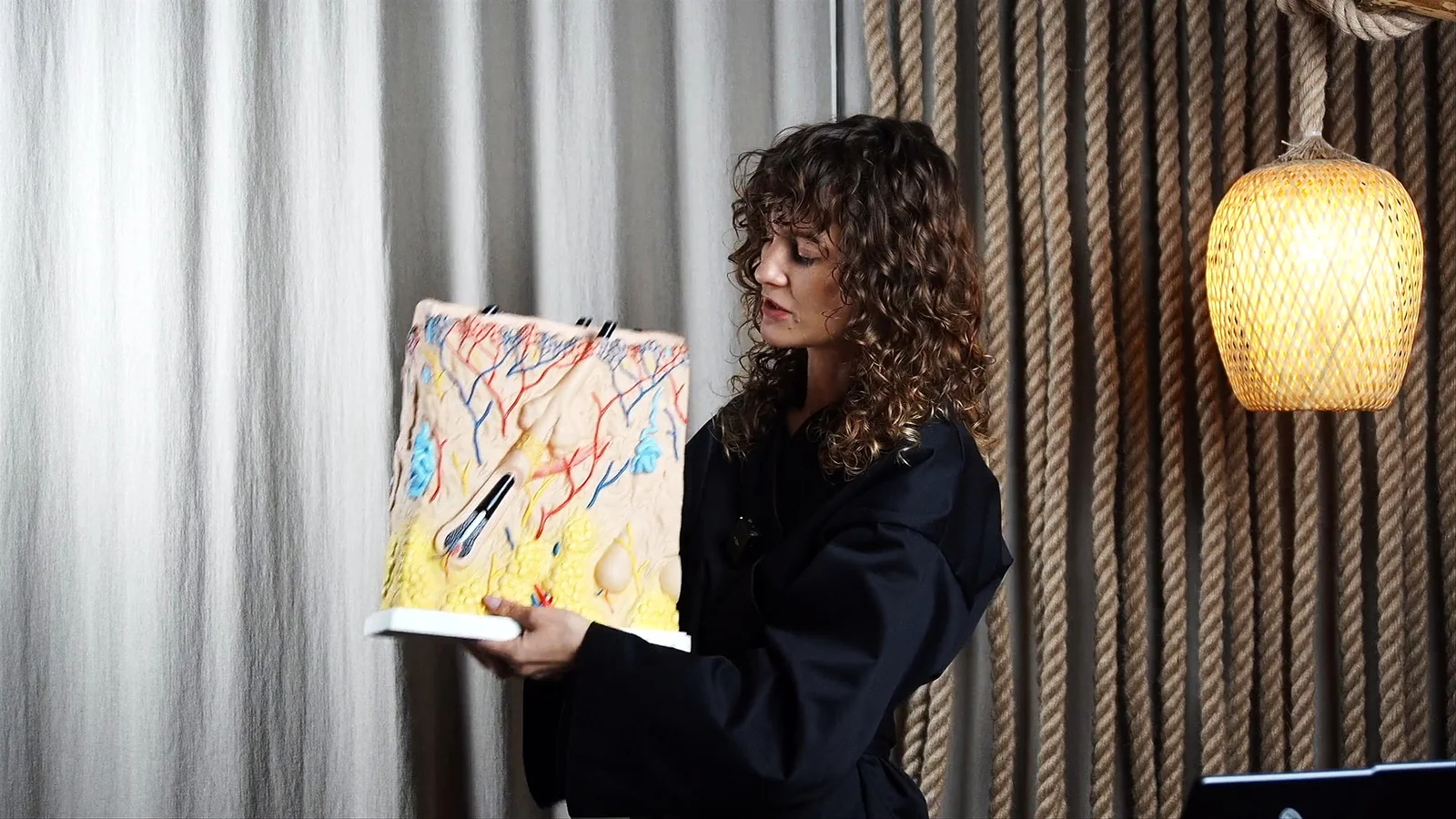
The starting point is dividing the hair into a living part and a dead part. From there, the course moves through the arrector pili muscle, sebaceous glands, the hair matrix and papilla, the five layers of the epidermis, and the network of blood vessels you stimulate with every massage at the basin. The second part is about recognition: telogen effluvium and androgenetic alopecia, how to tell them apart during a consultation, alopecia areata, anagen effluvium and trichotillomania, plus scarring alopecia, after which hair no longer grows back.
In this course, you'll see
- How hair is structured from the matrix and papilla to the cuticle scales, and why hair is the last part of the body to receive nutrients
- Where scalp pain after a full day in a tightly pulled hairstyle comes from, and the role the arrector pili muscle plays in it
- Why minoxidil lotion only works while you're using it, and what happens once you stop
- How to distinguish telogen effluvium from androgenetic alopecia in a consultation, based on a single question about the amount of hair shedding
- What hair follicle miniaturization and shaft heterogeneity are - why a client feels a thinner ponytail even with the same number of hairs
- Which types of hair loss leave a scar, and why new hair won't grow back there
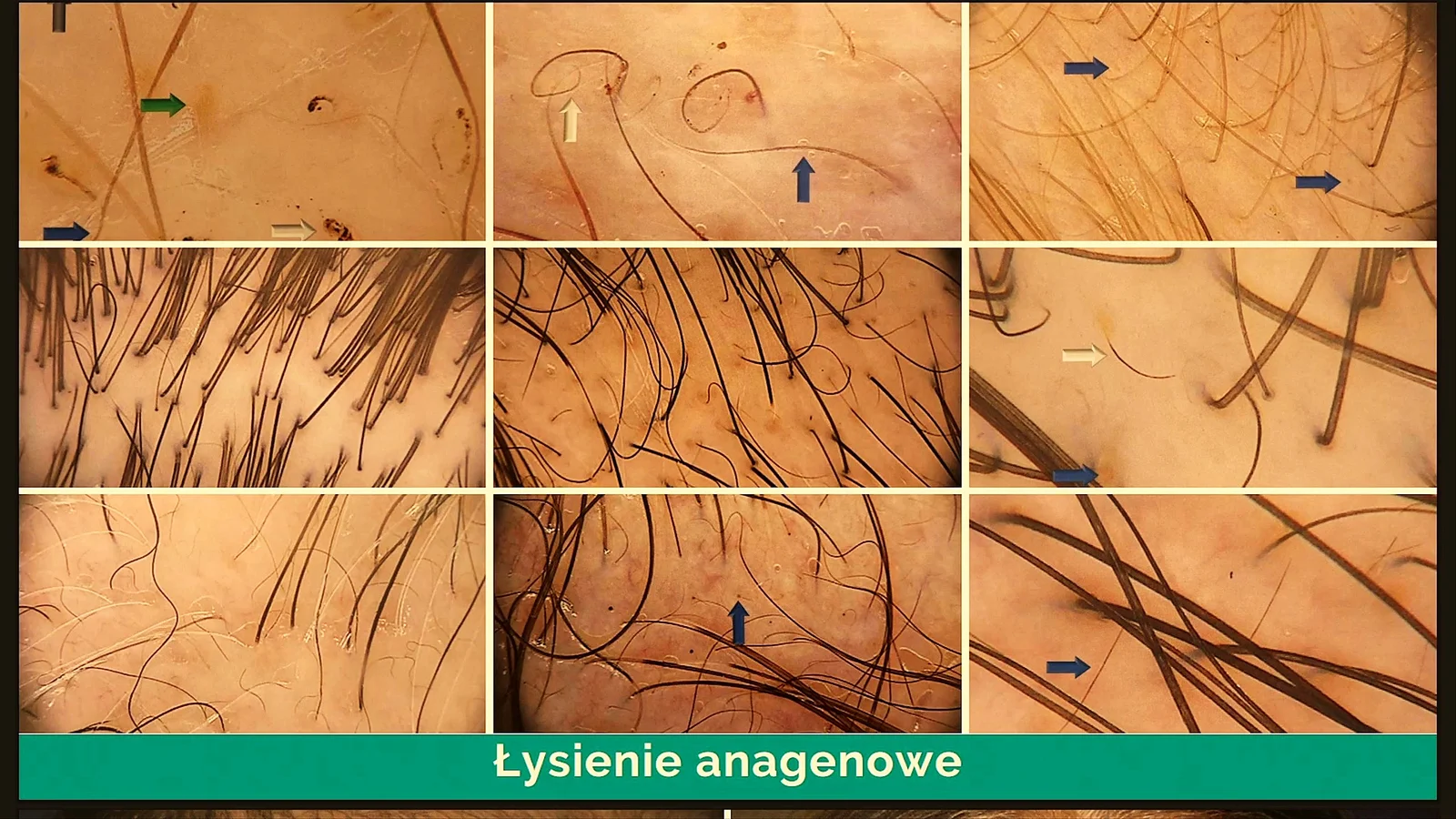
- What black, yellow, and white dots at follicle openings mean, plus flame hairs, exclamation-mark hairs, and pigtail hairs
- How the hair growth cycle works and what actually extends the anagen phase
This course gives hairdressers the language and the criteria they need. By the end, you'll be able to tell when a scalp condition is physiological, when it calls for trichological stimulation, and when a client needs to be referred to a doctor. Together with Trichology Consultation and Trichology in Practice, it forms a complete set: theory, the consultation process, and salon habits.
What you will learn
- 01How to distinguish telogen effluvium from androgenetic alopecia right from the client consultation.
- 02How hair is structured, and why nutrients reach it last.
- 03What hair follicle miniaturization is and how to spot it.
- 04Which types of hair loss leave a scar, and when to refer a client to a doctor.
- 05What black, yellow, and white dots at follicle openings mean.
- 06How the hair growth cycle works and what actually extends the anagen phase.
What's inside
Full access with the course 1:50
1:5001Hair splits into a living and a dead part
Everything that happens above the skin's surface is the shaft - and that's the dead part of the hair.
 3:09
3:0902Where scalp pain comes from
Very often that arrector pili muscle gets pulled in a completely different direction, and at that point it's simply strained.
 5:55
5:5503Hair is nourished last
Hair is treated as a vestigial organ, so if it's going to get anything, it's only at the very end.
 8:27
8:2704What happens after you stop using minoxidil
Unfortunately, a large portion of the hair that managed to grow starts falling out.
 11:16
11:1605You only see one of the five layers
The stratum corneum is just one of the five layers of the epidermis.
 16:09
16:0906How deep a massage really reaches
Your stimulation reaches all the way down to the muscle.
 18:05
18:0507One question that separates two types of hair loss
When a client tells you they're pulling out huge amounts of hair, that's telogen effluvium.
 19:23
19:2308Hair follicle miniaturization
What happens is a phenomenon called hair follicle miniaturization.
 28:31
28:3109A scar means the end of the follicle
Wherever a scar forms, there's absolutely no way for a follicle to miraculously regenerate there.
 31:48
31:4810What you must never promise with psoriasis
Psoriasis is an autoimmune condition, so we absolutely never promise anyone a cure for it.
 38:18
38:1811Flame hair and trichotillomania
Because the camera doesn't lie.
 39:20
39:2012How many hairs a blonde has versus a redhead
People with light hair - blondes - have the most hair, around 120,000 strands.
 43:21
43:2113What trichological work actually involves
All of this contributes to extending the anagen phase.
 45:16
45:1614Trichosiderin is not a melanin
If anyone tells you there's such a thing as trichosiderin, that is absolutely not a natural hair melanin.
FAQ
Is this course suitable for hairdressers with no trichology background?
How does this course differ from Magdalena Koc's other two courses?
Do you need a trichoscopy camera to take this course?
Does the course teach how to interpret blood tests and choose supplements?
Can a hairdresser work with scarring alopecia?
How long is the course?
Details
Educator
Magdalena Koc
Educator · 3 courses
Magdalena Koc is a hairdresser, trichologist, dietitian, and lead educator at the Hair Spa Edu Training Academy. In her work, she brings these specialties together, showing how a client's everyday habits and lifestyle affect the condition of their hair and scalp. She teaches how to accurately diagnose the root causes of problems-rather than just treating their symptoms-through careful observation and conversation in the salon. Her methods are built on understanding the client's complete health picture.
Ready for the next level
Unlock full access to the Connected Hair course library.
Join the Academy