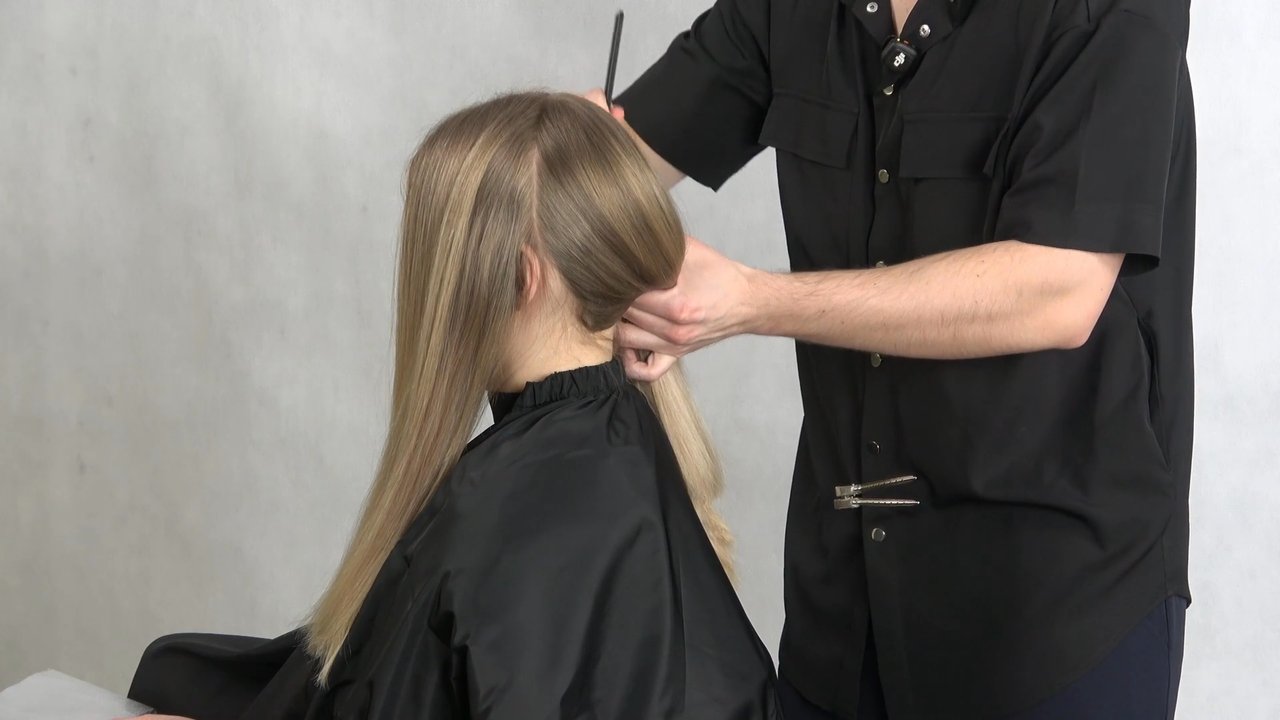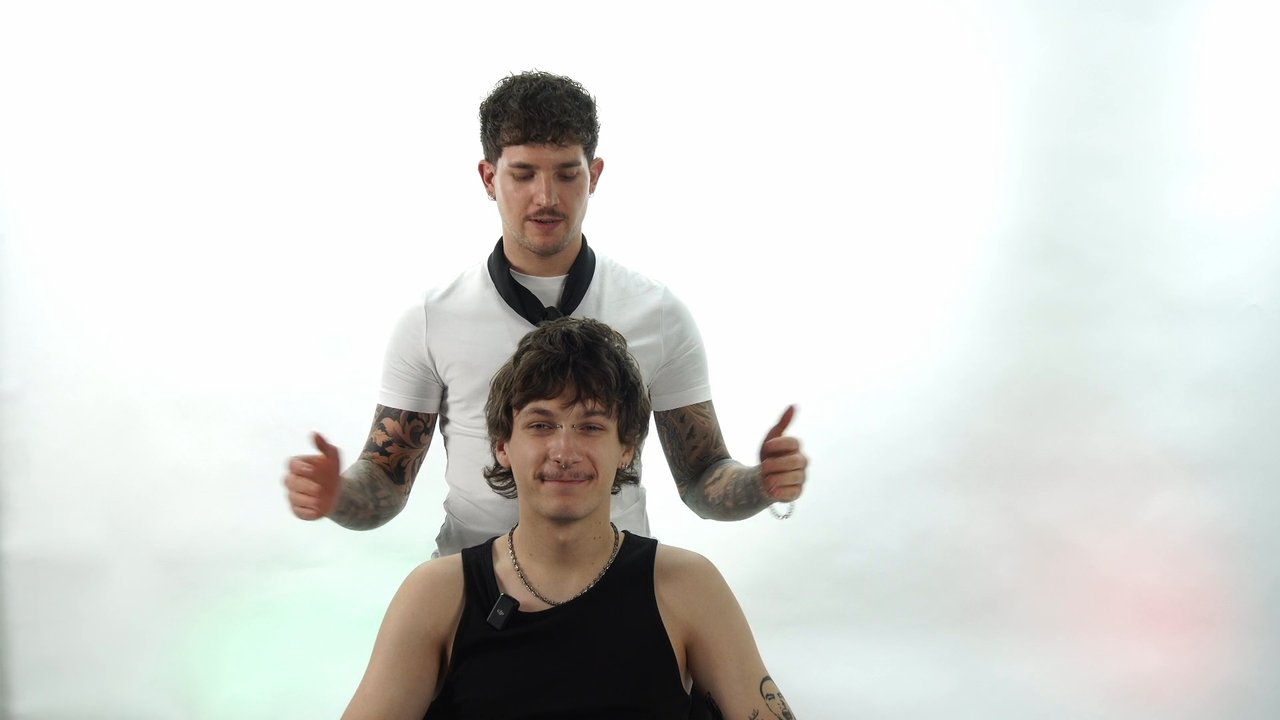
Hair with a middle part can turn tame exactly where it was meant to be aggressive. All it takes is for the weight to spread out to the sides, and the haircut's waist disappears, leaving the head looking like a helmet. Michał Daniel built his structural middle part around exactly this problem: where to leave length, and where to pull out a sharp, square outline.
The structural middle part is a men's mod with a center part that stands on a strong, square shape and smoothed-out disconnection rather than on length alone. The weight is pulled out to the sides and upward, the nape is smoothed into a fluid waist, and the fringe comes down as an aggressive, textured edge. It's a version for people who like longer material on top but don't want the haircut to turn round and shapeless.
How the structural middle part differs from a regular mod
The difference lies in the shape, not the length: here everything is deliberately directed into a square with sharp corners, instead of being left to its natural fall. A classic middle part often melts down the sides and turns into what Michał calls a helmet — a tame, round shape with no waist. The structural version deliberately builds aggressive ends, a strong square on the sides and top, with the bottom closed off by smoothed-out disconnection.
Among related haircuts, it sits closest to the mullet and layered mods: the same family of longer, characterful men's cuts, where length on the sides and nape is an asset, not a problem. What sets Michał's project apart is the hard emphasis on a square outline in both planes, vertical and horizontal, and on disconnection that only gets melted into a fluid line at the very end.
A haircut that's supposed to be aggressive ended up, paradoxically, a little too tame.
Michał Daniel
Who the structural middle part is for
It works best on people with longer material on top who want a characterful, aggressive haircut but lose the waist and character once the hair spreads out to the sides. Hair with a slight bend, or hair that springs back nicely, sits well into this shape, since it's easier to pull chaos and volume out of it. Michał deliberately doesn't shorten the ends where the hair is a bit frizzy or thinner, so it doesn't end up looking empty.
The square outline and pulling the head upward give the haircut sharp corners and a clear waist instead of a round shape. This is a cut with character, deliberately more aggressive than the conservative classic, designed around the whole client, not just the hair itself:
I try to get an initial read on his whole vibe before he even sits down in the chair.
Michał Daniel
How the structural middle part is built step by step
The whole thing stands on four sections and one assumption: we're building a square, aggressive shape instead of a natural, round one. Michał Daniel divides the head into two side panels, a back panel, and a top panel, then guides each one toward strong corners.
Michał's shape plan looks like this:
- Back panel: the main length is cut to the line under strong tension, on the inside of the fingers.
- Upper occipital area: redirected into a vertical triangle, with radial sections from a single point, where finger knuckles placed on the occipital bone set the length and disconnection from the nape.
- Nape: initially left disconnected, then smoothed at the end with a slide to achieve a fluid waist without a hard cut-off.
- Side panels: section number one in disconnection, the rest guided square in both planes, in vertical sections, to pull the head upward.
- Top panel: round vertically, square horizontally, for maximum aggression and sharp corners.
Watch how Michał sets out the entire vision for the cut right at the start and explains why he wants this square outline:
This one direction — square instead of round — comes back later on every panel. Thanks to this, the haircut doesn't widen the head; it pulls it upward and builds the waist.
What's characteristic of Michał here is his work with tension and the baseline. He rewets the hair every time it starts springing back or puffing up from the root, because better tension gives a cleaner cut. He only makes the cut once he can clearly see the baseline — the reference line from the previous section.
Thinner sections and shape control
Michał consistently chooses two thinner sections instead of one thicker one, so as not to create too big a redirection. A section that's too thick tempts you to pull the hair too hard in one direction, which can ruin the final shape. Thinner sections give more control over the square and cleaner work.
The same thinking drives the sections on the sides: the side panel is cut in vertical sections, with length carried over from the back, so the square holds up in both planes. At ear level, Michał leaves the sideburn in disconnection and redirects the front into the section above the ear, which gives elongation toward the face to be used in styling.
Smoothing out the disconnection with a razor
The disconnection at the nape is melted at the very end, with a razor, so the waist is fluid but the haircut doesn't turn into too big a jellyfish shape. Michał first leaves the nape disconnected, and only decides whether to smooth it once he sees how the whole back behaves. He works with a sliding motion, section by section, catching the length off his knuckles and sliding downward.
Watch the moment Michał assesses the shape and decides the disconnection needs to be smoothed out, instead of being left as a hard cut-off:
The result is a fluid waist with no hard cut-off line, while keeping an aggressive shape in the upper occipital area. Short where it needs to be short, with the length behind the ear left untouched.
Textured fringe with a razor
Michał shortens the fringe with a razor, using a sliding motion, because he's after texture — an irregular, choppy end — not a straight line. He first checks the growth pattern and the symmetry of the widow's peaks to set the fringe according to the client's natural line. Then he pulls the hair out without heavy tension and slides through it, so it ends up both lighter and shorter.
Watch how Michał explains his choice of razor and how he guides the slide through the fringe:
The fringe sits about a centimeter, a centimeter and a half above the eyebrows and blends into the disconnection at the sideburns, adding a playful touch to the haircut. It's what gives the contrast to the longer rest and closes off the whole square outline. You'll find a similarly textured approach to the fringe in the related messy taper, just in a shorter, more compact form.
Styling the structural middle part
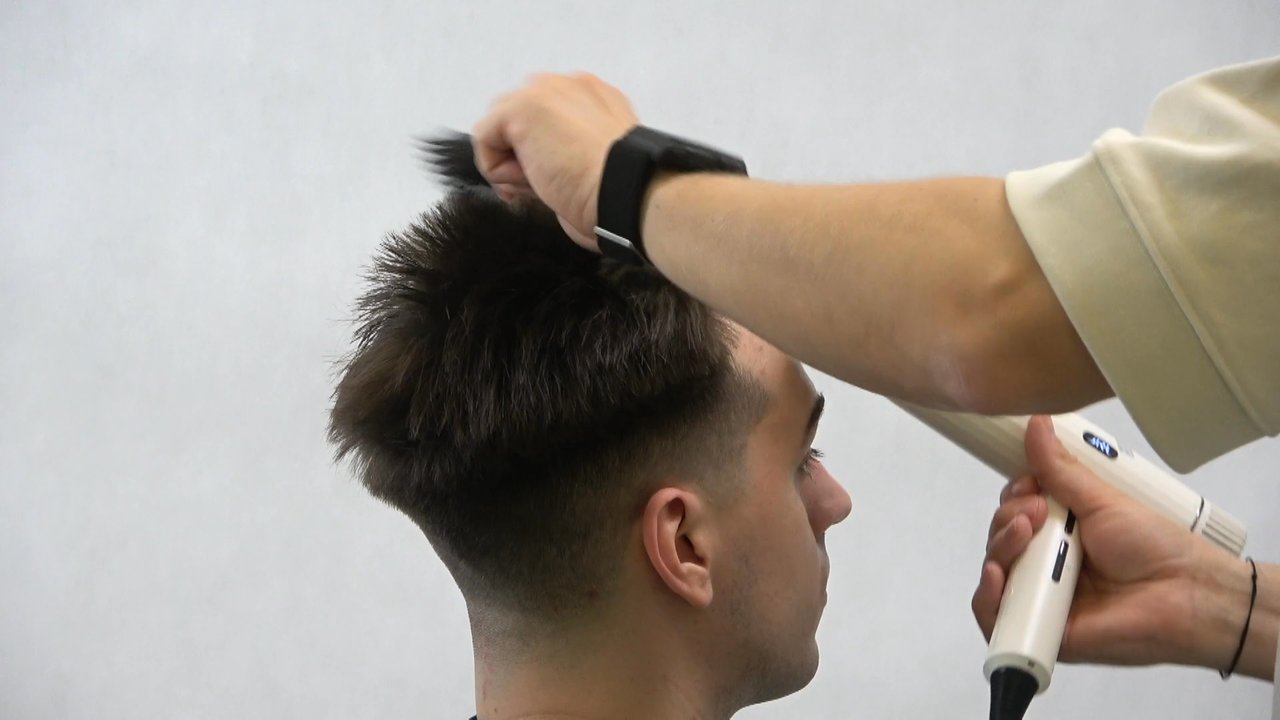
The hair is dried without a diffuser, to its natural fall, with a touch of sea salt for volume, and the shape is finished with matte clay. Sea salt slightly roughens the hair, so it behaves better and picks up volume. Michał dries alternately from the top and the bottom, by hand and with airflow, so the disconnections reveal themselves naturally, and around the nape and ear he uses cool air so as not to burn the client.
He applies more product as a light mist, first rubbing it between his hands so it doesn't clump in one spot. The matte clay gives one hundred percent matteness and workability, and where the shape needs stronger hold, hairspray comes in. A lot of the work goes into volume at the sideburns and a slight dip in the rounded zone, and the styling is done mostly by hand, since a haircut like this will get tousled by the client throughout the day anyway.
How long the structural middle part holds up
The outline and length hold up for a long time, because the weight is deliberately distributed rather than concentrated in one spot. The most protruding point at the back of the head stays short, almost finger-width, while the rest builds up over the curve of the head, so the shape grows out evenly instead of melting into a helmet. This cut is designed so that, weeks later, it still reads as an aggressive, square mod rather than a tame, round haircut.
If your middle part is spreading out to the sides and turning into a tame helmet instead of an aggressive haircut, it's a matter of shape and weight distribution. Michał Daniel shows the entire cut step by step in the Structural Middle Part course: how to build a square outline across four sections, guide radial sections with a baseline, smooth out disconnection with a razor, and texture the fringe with a slide.