Lightening and decolorization
 The result and the process
"Lightening " is a course that covers two seemingly opposite processes: decolorizing dyed hair and pigmenting gray hair. They share a common denominator—working on hair without natural pigment, which requires a completely different approach than standard coloring. The course demonstrates how to strategically tackle the most challenging cases in the salon: from removing years of dark, store-bought dye to achieving 100% coverage of stubborn, glassy gray hair without creating a flat, dull effect.
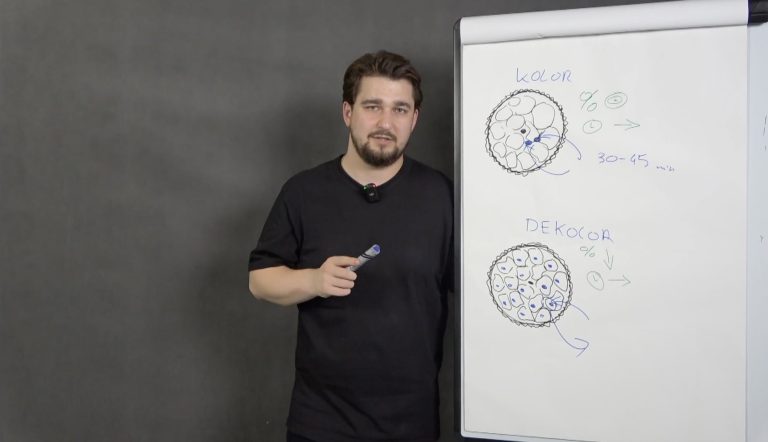
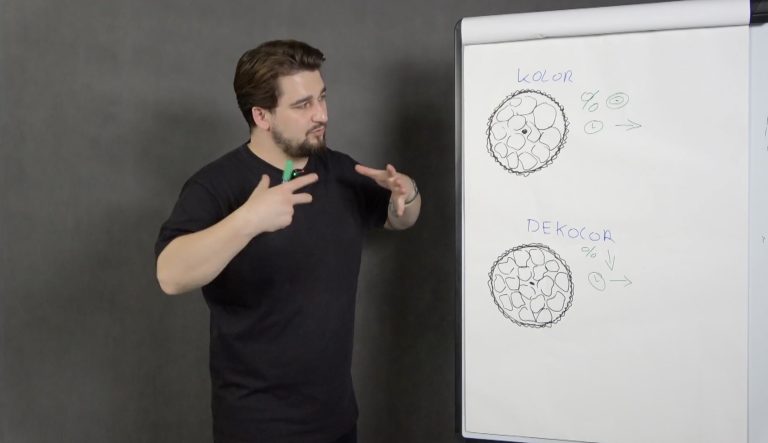
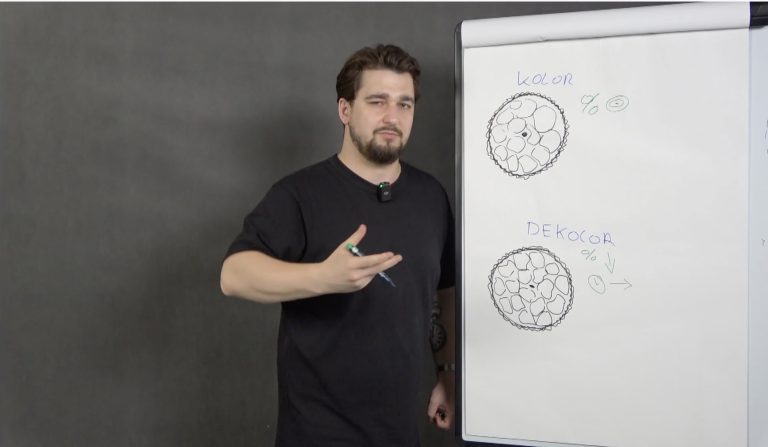
Bartłomiej Lacz guides us through the chemistry and logic of both processes, from the structure of the hair to the action of specific ingredients in the mixture. He explains why a low-strength oxidizer and a longer bleaching time yield a cleaner result than a high concentration applied quickly, and when a 3% solution is sufficient to fully cover gray hair. On a flipchart, he visualizes how pigment precursors work in coloring and ammonium salts in the lightener, providing tools for informed work planning rather than just replicating formulas.
In this course, you'll learn:
- The true meaning of coverage percentages on paint – why 50% coverage won’t cover 30% of the gray hair on the head, and how this knowledge changes the choice of mixture.
- The principle of working with “fresh developer” – why mixing small batches every 15–20 minutes is the key to even bleaching from the nape of the neck to the crown of the head.
- The technique of adding golden pigment to cool-toned mixtures for gray hair to achieve luminosity and richness, rather than a warm tone.
- Why does henna decoloration result in green or turquoise highlights, and how does it fundamentally differ from removing oxidative pigments?
- When is a 3% oxidizer sufficient to cover 100% of gray hair, and when do you need to use a 9% oxidizer? The answer depends on the hair’s texture (glossy vs. dull).
- The difference between a pigment precursor and the pigment itself—and how understanding this process helps prevent insufficient coverage of gray hair.
After this course, you’ll stop treating decoloring and gray coverage as an unpredictable gamble. You’ll understand the chemical fundamentals of both processes, allowing you to consciously select the right products, timing, and techniques for each specific hair structure and its history. You’ll turn the salon’s toughest cases—from stripping black dye to stubborn gray hair—into opportunities to showcase your craft based on knowledge, not luck.
 What's inside
Full access to the course
 What's inside

Cool-toned dye on gray hair
"A very cool paint will definitely give me a more intense result in terms of color saturation."

Selecting an oxidizing agent based on hair structure
"You don't always need to use a high-strength developer; many hair types can be lightened even with a 3% developer."

Gold pigment in a cool color scheme
"It's a good idea to add a little bit of, say, gold pigment to a mixture like this."

Step-by-step application and removal of the lightener
"We can apply some, wash some off, and keep applying more."

Hair coloring chemistry - pigment precursor
"The first component is called a pigment precursor, which penetrates deep into the hair shaft right from the start."

Unusual results from henna lightening
"With henna, hair lightens from brown to green, and then to turquoise-blue."

The golden rule: always use fresh bleach
"I have to keep using fresh bleach all the time."

The Role of Consultation in Difficult Cases
"One thing we can always do is find out as much as possible during the consultation."
 Frequently Asked Questions