Fade
 The result and the process
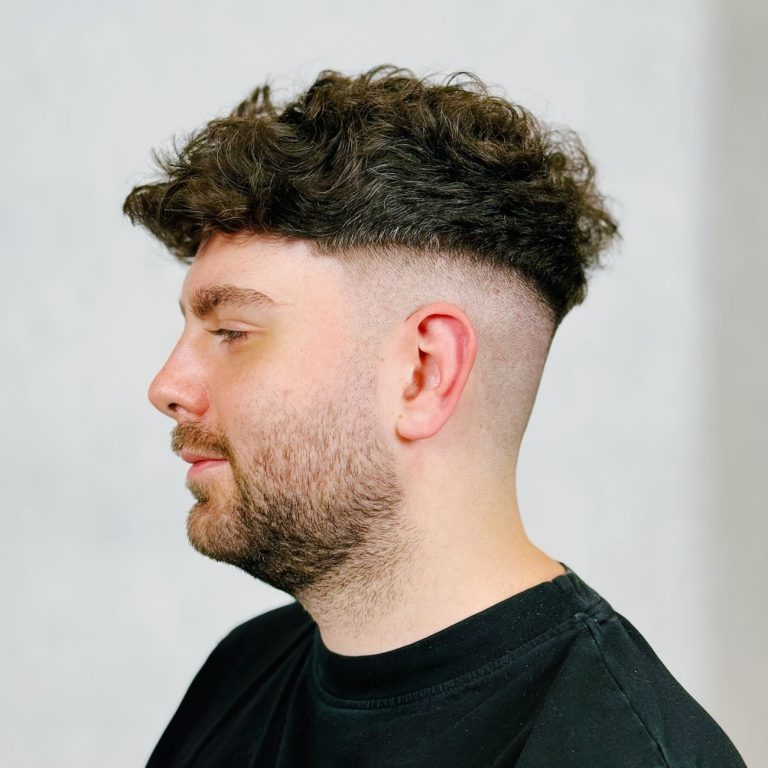

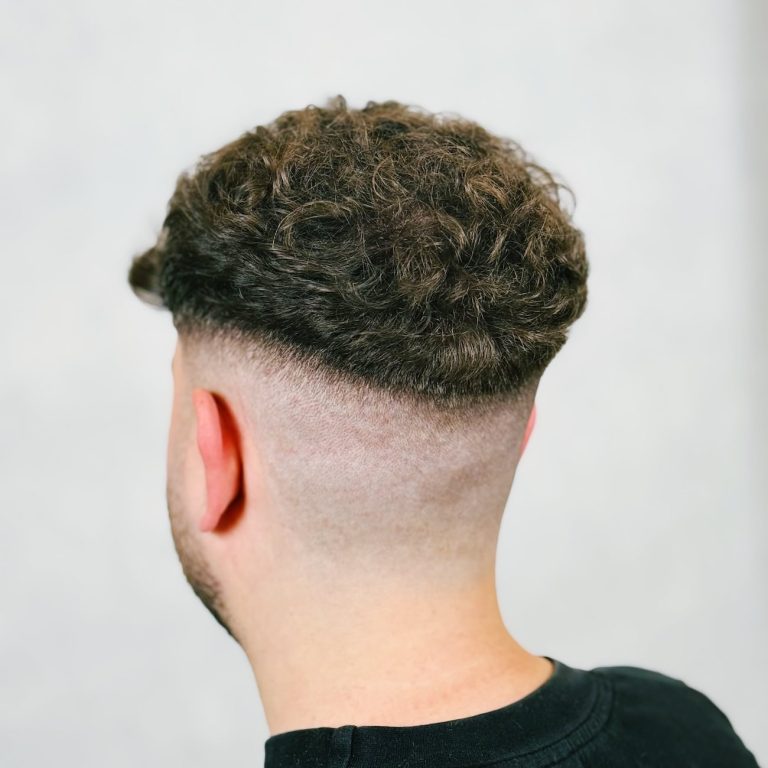
Fade is a proprietary zone-shading method that transforms one of the most popular men’s hair techniques into a repeatable, controlled process. The course shows you how to create a smooth gradient from scratch on any hair type—including difficult, thick, and dark hair, where every mistake is immediately visible. The key is to divide the shading into three logical zones (light, shadow, and mid-tone) and to work with the clipper flat against the hair, without jerking your hand nervously.
Kacper Trzaskowski walks us through his complete workflow, which begins long before he even turns on the clippers. The process starts with a precise analysis of the head—identifying the hollows and the occipital bone, which we never thin out. Next, Kacper demonstrates how to shape the hair with scissors, creating a subtle layering on the curls to build volume and facilitate the later transition into the fade. Only then does he proceed to methodically cut out sections with clean, sharp lines, which he then blends into a perfectly smooth gradient.
In this course, you'll learn:
- Complete zone shading diagram: division into light, shadow, and mid-tones, and adjusting the width of the zones to hair density
- Flat-footed skating – why it’s the key to control and how to avoid the “flick” technique when building up speed
- Preparing the shape with scissors using a fade technique on curly hair – low graduation as a way to straighten curls at the hairline
- The principle of avoiding the occipital bone and consciously working in the depressions on the head to avoid spots in the gradient
- A complete guide to working with brush tips: from building the base line with a size 4 tip, to defining areas with sizes 2 and 1, all the way to the final shading
- Why do you need more “light” (wider, lower sections) with thick, dark hair, and how to plan for it
- Finish by running a detangling comb and scissors along the hair for perfectly smooth results
After this course, you’ll stop struggling with “difficult heads” and start consciously designing fades tailored to your client’s anatomy and hair structure. The zone-shading technique will give you consistency and the confidence that the gradient will be smooth and clean every time, without patches or imperfections—even if the lighting in your salon isn’t perfect.
 What's inside
Full access to the course
 What's inside

Analysis of indentations on the head
"To start with, I always check where the indentations are on the head."

Inner-side shading technique
“Why do I shape the palm on the inside of my hand? Mainly because I need to create a triangular shape.”

The need for a cross-check with a square
"Once I finish this pile, I'll come by to do a cross-check, especially on the square."

Proper use of a hair dryer and brush
"Remember, the nozzle on your hair dryer should be an extension of your brush. We don't dry it like this—only like this."

How to use a flat-bed machine
"It is very important that every section we cut is cut completely flat."

The purpose of creating hard lines
"It is thanks to them that we are able to determine what gradient we will reach at what altitude."

Working in the head cavities
"If I see a dip, I just drive right into it—I don't hold back at all."

Careful connection to the scale line
"You definitely have to be extra careful in this area so you don't cut too deeply into the mold."