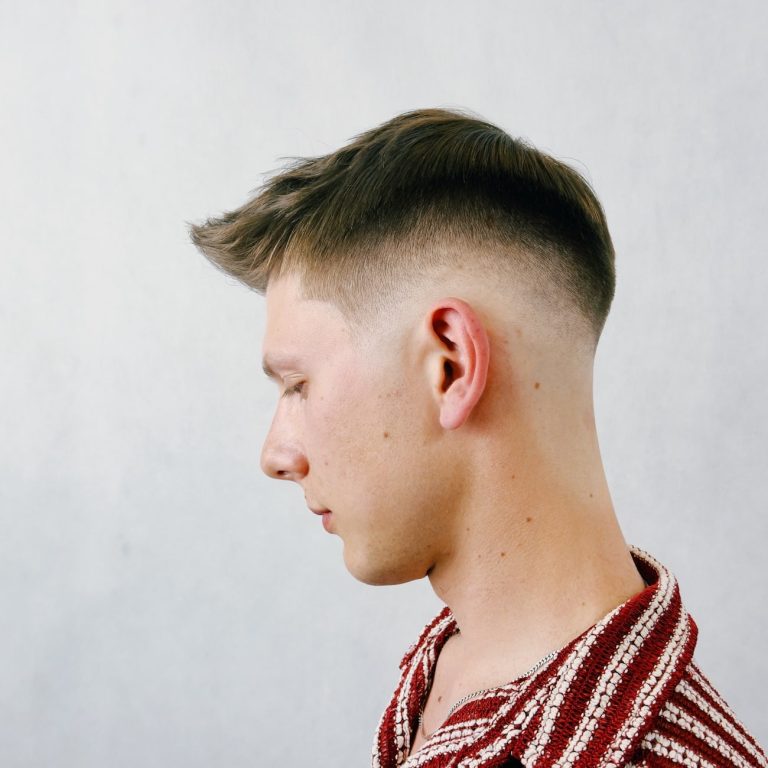
Fade from scratch, three-sector system
 The result and the process


 What you'll learn
 What you'll learn
How to create a smooth transition step by step using the three-sector system.
How to assess hair density and color in order to plan your highlights effectively.
How to create a zero line with a razor to avoid sharp edges.
How to style thinning hair at the temples to maintain volume along the hairline.
How to review your work from three different perspectives to avoid mistakes.
How to combine layering with longer top hair using thinning shears.
"Fade from Scratch " is a systematic approach to blending that transforms chaotic clipper work into a repeatable process based on a three-sector system. The course shows you how to create a clean, smooth fade on any hair type—from thick and dark to light and thin—eliminating guesswork and giving you full control over how much light reaches the scalp.
Natalia Przytuła guides you step by step through the entire process, from the fundamentals of light and hair analysis, through key preparation and smoothing, all the way to the core of the method—working in three sections. Each section is a distinct stage with three precisely selected lengths, allowing you to build transitions systematically rather than by feel.
In this course, you'll learn:
- The three-sector system in practice – each zone (e.g., 3 mm → 1.5 mm → open blade) is a closed, repeatable process of building a transition
- Hair assessment – how to evaluate density and color in order to plan the zero line height and transition width effectively
- “Work Checklist” – a quality control system based on three perspectives (standard, mirror, two steps back) to catch errors that aren’t visible up close
- Use a razor (not a trimmer) to create a close shave, and move the shaver in circular motions to avoid leaving any rough edges
- How to work on the thinnest areas (temples) without losing the volume needed to create a sharp contour
- Combine the shading at the top with thinning shears (“frame”) to seamlessly integrate the fade with the rest of the hairstyle
- How to identify and deal with "black dots"—individual dark hairs that disrupt the smoothness of the eyeshadow
After this course, you’ll stop struggling with shading imperfections and start creating them in a deliberate and fully controlled manner. The three-sector system will give you the confidence to handle any hair type, and the work checklist will allow you to finish the service knowing that the fade is clean and polished from every angle.
What's inside
Full access to the course
 What's inside

The key brush stroke during preparation
"The correct brushstroke will look as if you were drawing a U starting from the center."

Marking the base with marking pins
"Using a closed-end thinning shears, I lift the hair and trim off the excess."

The concept of hair classification
"Hair density refers to how much light enters the scalp."

The zero-line drawing technique
"We'll draw the zero line this way in one direction, by shifting the machine."

Leveling with an open-bladed tool
"I always divide an open blade into three categories: fully open, half-closed, and closed."

Watch out for 'black hairs' that disrupt the shadow
"You might notice a few stray black hairs that will ruin the look."

Joining lines using the frame method
"We can tilt the comb slightly so as not to create another line at the top."

Building the outline - finding the triangle
"We're looking for the triangle on this page and trying to highlight it."