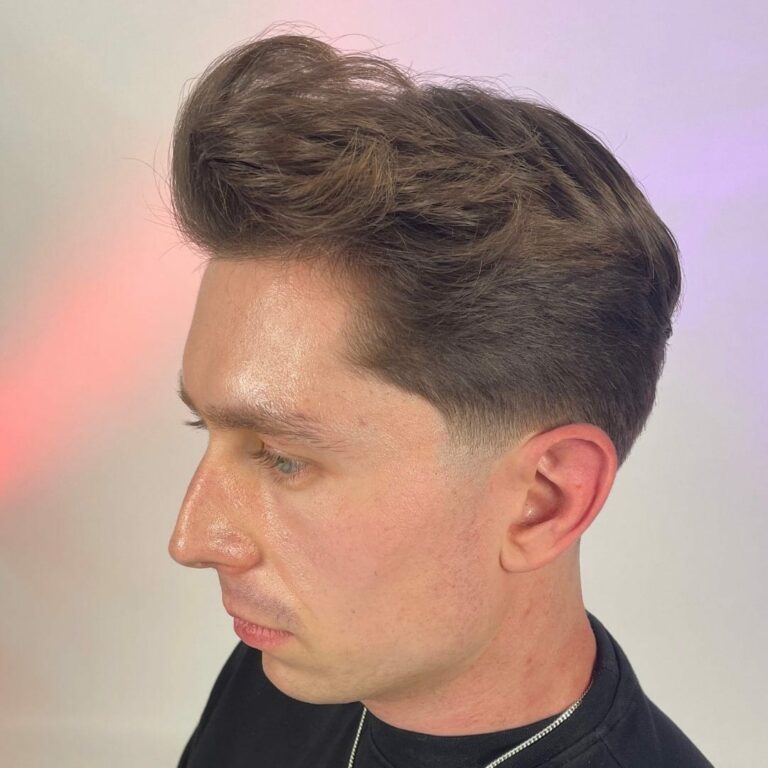
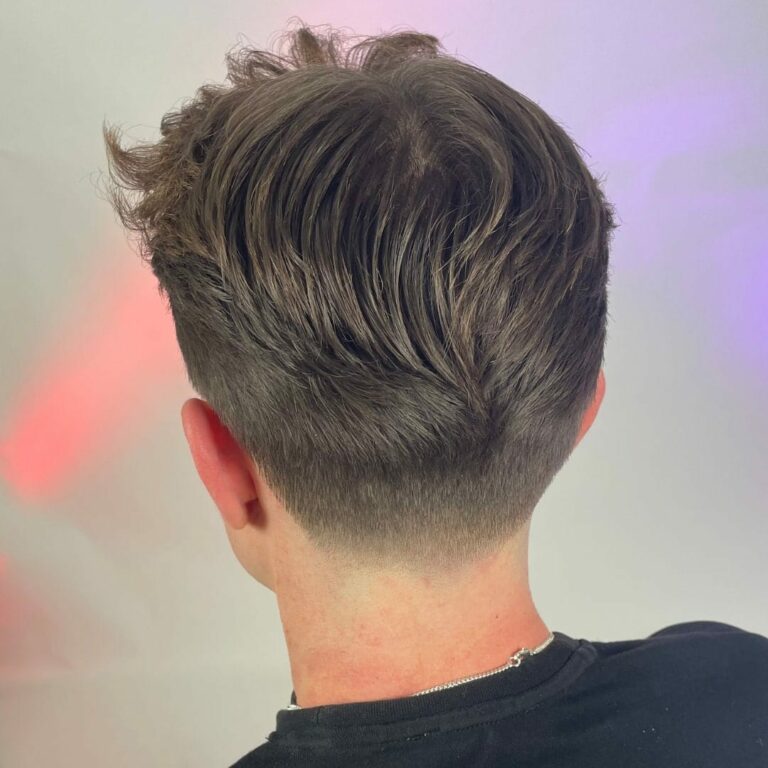
Messy Chic Pompadour
 The result and the process

 What you'll learn
 What you'll learn
How to add volume and texture to fine hair with a "layered" cut.
How to create an aggressive taper fade using the "inward" technique starting from scratch.
When to use a wrist motion and when to use a shoulder motion when using a clipper.
How to style an asymmetrical part into a triangle that follows the natural hairline.
How to build volume on the sides using layered cuts on diagonal sections.
How to adjust the taper to a difficult head shape and areas of hair loss.
A modern, loose tapered pompadour is a haircut that combines the volume and texture of a square top with the clean lines and precision of a low-set taper. This course demonstrates how to create a dynamic, masculine style on fine, wavy hair that retains lightness and natural movement, while remaining easy for the client to style on a daily basis.
Mateusz Banaszek guides you through the entire process, starting with a detailed analysis of the head shape and hair condition, which determines the next steps. You’ll see how an asymmetrical triangular section simplifies the process, how to build volume on the sides using layered cuts on diagonal sections, and how to add volume to fine hair on top with a quick, rhythmic cut. Working with clippers is a separate, precise technique for building a taper from the bottom up.
In this course, you'll learn:
- The complete process of creating an aggressive taper using the "inward" technique: trimming the hairline with a trimmer, cleaning up with a shaver, and blending from the bottom up (1.5 mm → 3 mm → 4.5 mm).
- Wrist-driven vs. shoulder-driven motion – the key difference in machine technique between shaping and pure taper shading.
- The "layered" cut as a technique for adding volume and definition to fine hair at the top – when it’s better than a feathered cut.
- An asymmetrical triangular parting that follows the natural hairline serves as the foundation for the entire hairstyle.
- Create layers on the sides using diagonal cuts to balance the volume and prevent the head shape from appearing too wide.
- Vidal Sassoon’s Cross-Checking Principle – Why cross-checking is the habit that distinguishes a craftsman from a master.
- How does an analysis of the head's shape (protruding occipital bone, recesses at the temples) affect the height and shape of the final taper?
After this course, you’ll be able to consciously use various scissor and clipper techniques to add volume and character even to difficult, fine hair. You’ll learn to create a modern pompadour with a taper as a cohesive, well-thought-out design, where every move—from sectioning to the final styling—is based on analysis and serves a specific purpose.
What's inside
Full access to the course
 What's inside

Analysis of the occipital bone
"My occipital bone is very prominent, so I know I'll have to spend more time on it."

The Importance of Cross-Checking in Haircutting
"Someone who doesn't cross-check won't become a great hairdresser, because they just can't be bothered."

Building weight and a triangle at the back
"I want to create weight, so I'm pulling everything down hard to form a quick triangle."

Blending the top with the back of the hairstyle
"I'm switching from horizontal cuts to diagonal and vertical ones to join the back."

Two key shaver strokes
"With the taper, we work with our wrists. Our shoulders are locked, so we only use our wrists."

The zero-line shading rule
"By pressing down on the razor while creating a line, we go against the very principle of the fade, or shading."

Smoothing the taper line with tapering tools
"I'm moving on to trimming the taper on the scissors. I'm using thinning shears to soften the line."

Styling as a hairdresser's signature
"We're not afraid to experiment with style. Remember, that's our signature."
 Frequently Asked Questions