Pompadour
 The result and the process
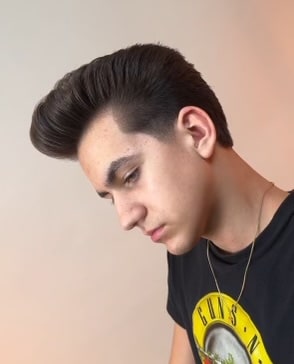
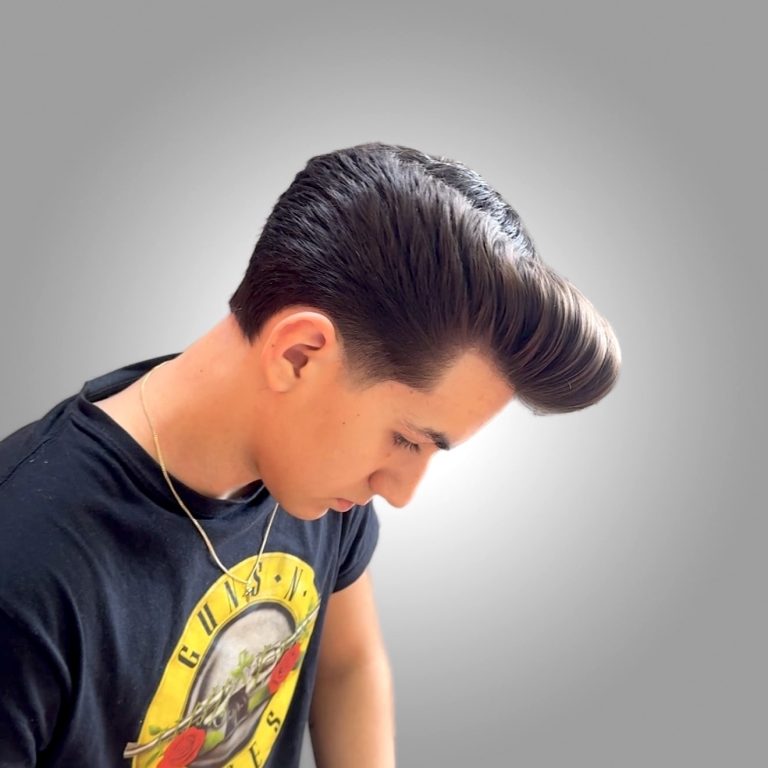
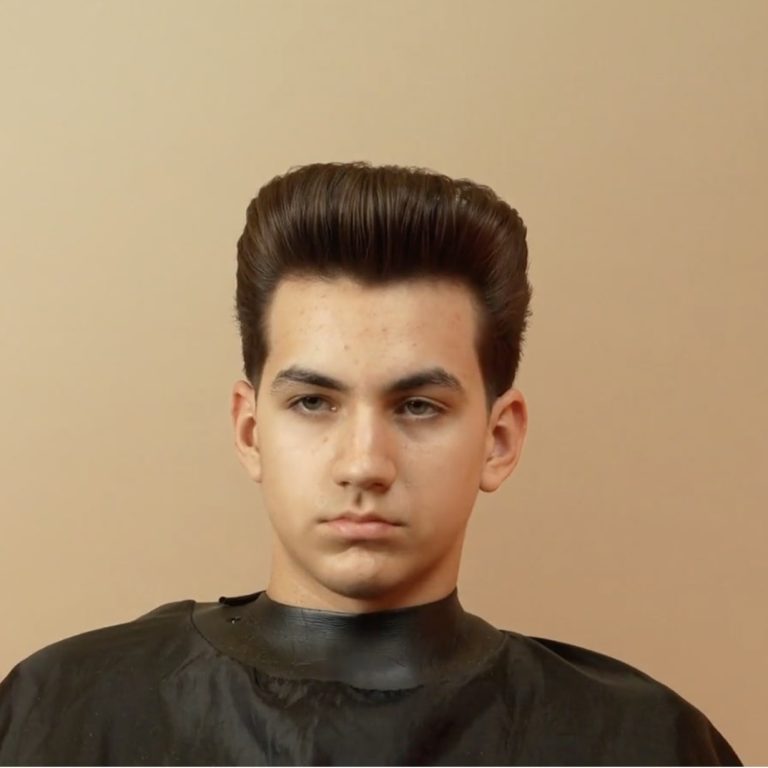
 What you'll learn
 What you'll learn
How to create a strip of hair around the head as the foundation for the entire hairstyle.
How to use your body position to create a square shape at the back and triangular shapes on the sides.
How to highlight your hair using the circular layering technique to achieve the perfect balance.
How to blend the sides with the top while keeping the longer bangs separated.
How to create texture on the surface using quilting and tempera painting.
How to create a precise taper fade at the temples and incorporate it into your hairstyle.
The pompadour is a classic men’s haircut, and in Paweł Pollheimer’s version, it becomes a precise exercise in creating a three-dimensional shape. The course demonstrates how to consciously control the hairstyle in two planes simultaneously: horizontally, creating a natural, rounded outline around the head, and vertically, building a triangle on the sides for volume and a square at the back for a flat profile. This is a technique for hairstylists who want to transform the classic into a craft based on geometry and complete control over balance.
Paweł Pollheimer guides you through the entire process, starting with the fundamental decision—defining a memory band around the head that determines the length and basic shape. He then demonstrates how to use the lift and direction of your own body (chest vs. abdomen) to sculpt vertical shapes—a square at the back and a triangle on the sides—without guesswork. The work on the top is a logical extension of the sides, maintaining the longer, separated fringe characteristic of the pompadour.
In this course, you'll learn:
- Defining a strip of hair around the head as the foundation for the entire hairstyle and ensuring balance between the sides
- How the direction in which the band pulls (toward the chest vs. toward the abdomen) directly creates a square or triangular shape
- A circular shading technique, where the shading lines run parallel to the outline—from diagonal lines near the face to horizontal lines at the nape of the neck
- Create a square shape at the top of the hair by working in horizontal sections from front to back
- Two texturing techniques: deep wet quilting for a firmer texture on the front, and tempera painting for lighter, feathered edges on the back
- A full haircut featuring a taper fade at the temples and precise beard line contouring
After this course, you’ll stop seeing the pompadour as a hairstyle to simply “style” and start consciously constructing it. You’ll acquire a system that gives you full control over the volume and shape of the hairstyle, ensuring a perfect balance between the left and right sides without constant checking. This knowledge allows you to create consistent, technically flawless classics that the client can easily recreate at home.
What's inside
Full access to the course
 What's inside

Marking the horseshoe from the wind
"First things first, I'll start with the horseshoe shape; I need to find the natural part using a comb."

Shaping the form through body position
"If I pull it toward the stomach, we get a more triangular shape. We'll make the back into a square."

Combining the side with the fringe into a triangle
"I create a lift—that is, a triangle—and then use the comb to form another triangle. Then I cut that section."

An Introduction to Circular Grading
"I'd like to show you one of the easiest and most enjoyable techniques—circular shading."

The logic of separation to maintain balance
"If, on the other hand, I choose the same separation, we'll have a good balance on one side."

Texturizing technique on bonded strands
"When selecting sections, we can use our fingers to pull them closer together and thus build up that texture more deeply."

Setting the zero line for a taper fade
"We'll draw a zero-zero line. We'll do this at the level of the brow bone."

The decision to go with a natural contour at the back
"I don't think I'll want to draw that line too sharply either. It will happen fairly naturally."