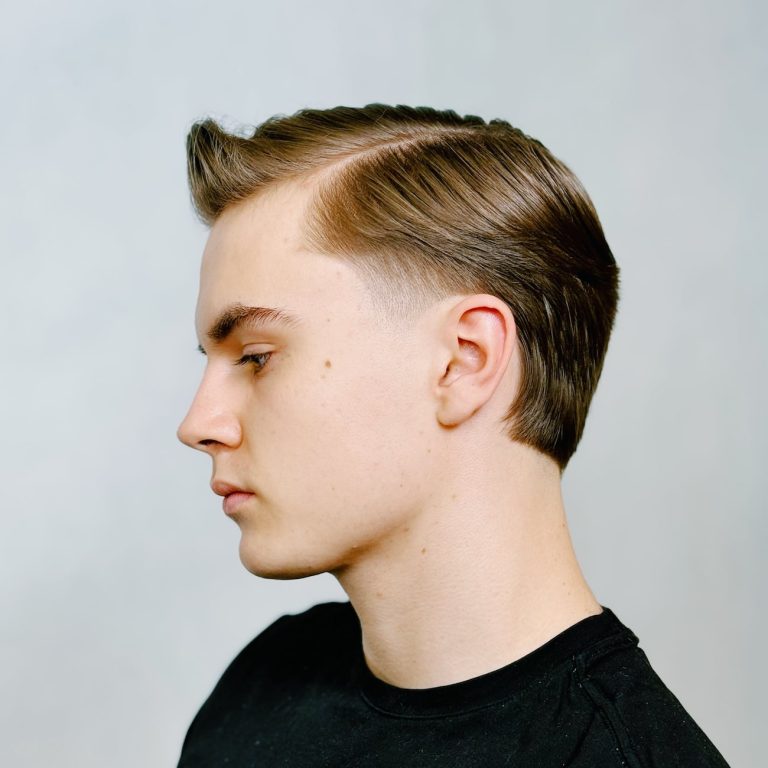
Side Part
 The result and the process


 What you'll learn
 What you'll learn
How to create precise layering at the back of the head using kinetics.
How to create a rounded top for a versatile look.
How to seamlessly connect the side, rear, and top sections without any gaps.
How to trim the sides with scissors to make blending with a clipper easier and faster.
How to layer the sides using two methods: the overcomb technique and just the attachments.
How to modify the T-shaped head division when dealing with problematic curves.
The Side Part is a classic men’s haircut that takes on a modern versatility in Miłosz Mikołajczak’s interpretation. The course demonstrates how to create a hairstyle on straight and thick hair based on precise layering, allowing the client to style it any way they like—from a classic side part, through a middle part, to a casual slicked-back look. This is a lesson in consciously combining fundamental shapes—the circle and the triangle—into a single, cohesive, and commercially viable whole.
Miłosz Mikołajczak guides you through the entire process step by step: from consultation and identifying issues (such as excess volume at the nape of the neck), through the deliberate division of the head into sections, all the way to blending all sections into a cohesive style without any disconnects. You’ll see how kinetics—that is, working with the client’s head position—becomes a key tool for building layers without constantly checking angles, and how wet scissoring creates the perfect canvas for the final clipper shading.
In this course, you'll learn:
- A systematic T-shaped hairline classification and its modifications based on the client's specific concerns (e.g., receding hairline).
- Creating shading at the back of the head using kinetics – how tilting the model’s head replaces the need to find angles with your fingers.
- Creating a circle at the top by working toward the axis of symmetry of each section—a technique that ensures even weight distribution.
- Two approaches to side shading: the overcomb technique (using a comb over the clippers) for speed, and the classic method using attachments in a descending pattern.
- A precise neckline with an unconventional fade—graded in the center and sharply trimmed on the sides with a trimmer.
- The technique of pointing on dry hair to soften the transitions and add lightness to the hairstyle without losing its shape.
- A step-by-step guide to the final styling, including how to find the client’s natural part using their hair.
After this course, you’ll be able to consciously shape a hairstyle by combining layering, circular, and triangular cutting techniques. You’ll understand how scissor work simplifies and speeds up the subsequent thinning with clippers, and your clients will receive a timeless yet modern cut that they can style in many ways depending on the occasion.
What's inside
Full access to the course
 What's inside

Analysis and a plan off the top of my head
"We need to work on the back so that we can gently lift the hair up."

The Key to Grading - Body Kinetics
"The key to shading is our kinetics—in other words, working with the head of our model."

Preparing the sides for trimming
"Using scissors can definitely make it easier to continue working with the clippers."

Creating a rounded shape at the top
"Let's form a circle so that the hair is distributed evenly."

Cutting technique along the axis of symmetry
"I try to find the axis of symmetry in my separation—that is, right in the middle."

Comparison of techniques: Overcomb vs. caps
"On one side, we'll use an overcombo, and on the other, we'll just use the attachments."

Layering the nape using the overcomb technique
"I think we'll take it step by step, just as I said at the beginning."

Creating a sense of lightness using the pointing technique
"We'll use a technique called pointing to smooth out that sharp line."
 Frequently Asked Questions