Disconnection and gradation techniques
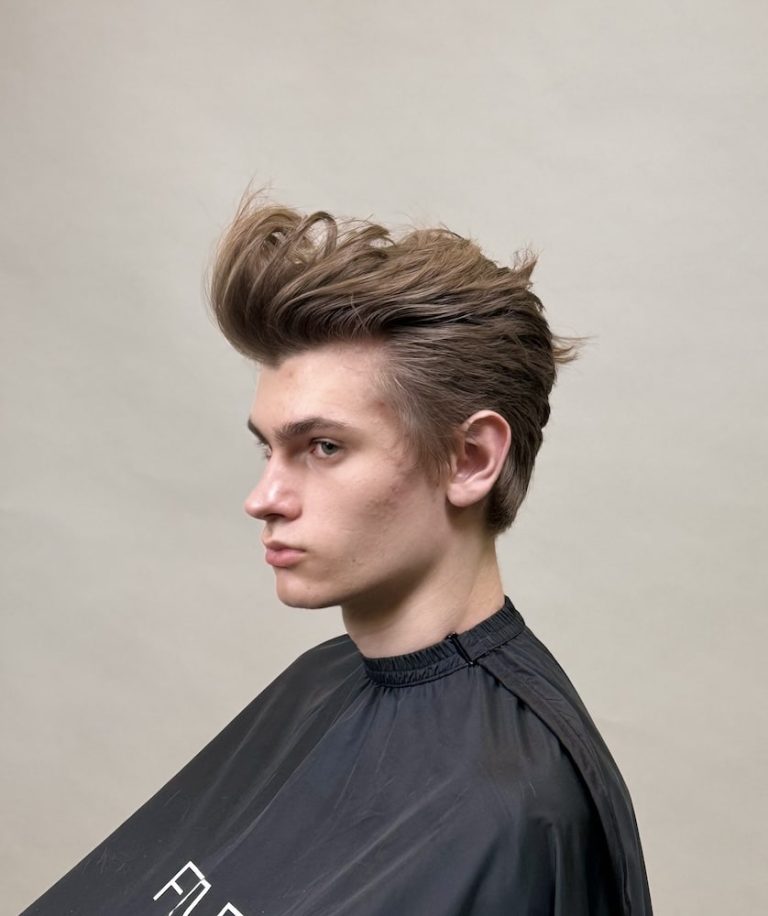
 The result and the process

 What you'll learn
 What you'll learn
How to create subtle layers at the temples and nape of the neck to add movement to your hairstyle.
How to combine a rounded taper on the sides with a square cut on top.
When to comb your hair over the head’s contour and when to comb it under it to control volume.
How to use a Chinese knife to blend sections and customize a hairstyle.
How to adjust the position of the client's head to precisely control the cutting angle.
Why you should leave a small triangle of hair at the front so you don't lose the width of your bangs.
Disconnection and layering techniques are used in this creative men’s haircut to reduce excess volume on the sides of the head and highlight the client’s strong facial features—cheekbones and jawline. The course demonstrates how to intentionally use two separated panels at the temples and nape to add modern accents and movement to the hairstyle while maintaining the overall shape’s cohesion. This technique is for the stylist who wants to transform a classic cut into a dynamic, character-filled style.
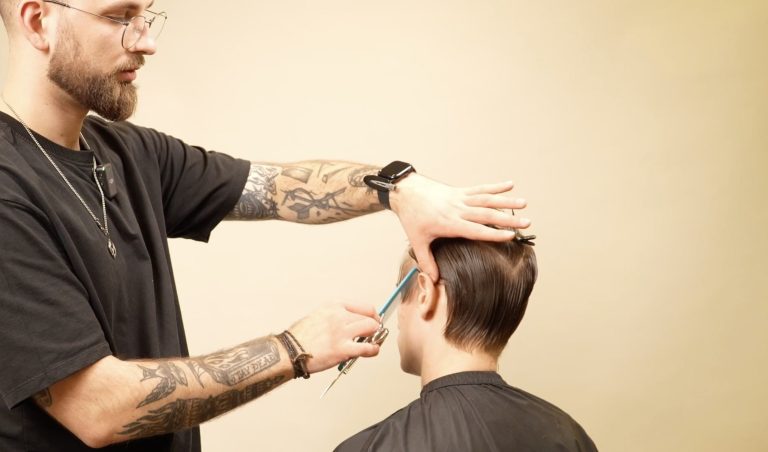
Marek Krzyminski guides you through the entire process, from analyzing the head and planning the sections to the final styling using a Chinese razor. Step by step, he demonstrates how to create a circular gradient on the sides and back of the head to control volume, and how to create a square layer on top to remove unwanted weight. The course focuses on a conscious approach to disconnection—so that it serves as a hidden tool that adds character, rather than a visible flaw.
In this course, you'll learn:
- Two cut-out sections at the temples and nape of the neck serve as a subtle detail that adds modern flair and movement to the hairstyle
- Creating a circular shape on the sides and back and a square layer on top – how to combine techniques that add and reduce volume in a single haircut
- Using a comb above and below the head’s contour—when to comb the hair from the top and when from the bottom to intentionally add or reduce volume
- Using a craft knife for dry-fitting and customization—how to create irregular, jagged edges that blend seamlessly with the whole
- Precise section planning, including a box section at the top with a triangular reinforcement at the fringe to maintain its width
- A complete styling routine from scratch: blow-drying with a narrow nozzle to create direction, and using a diffuser to achieve natural volume and movement
After this course, you’ll begin to consciously use disconnection as a tool for creating character, rather than just as a technique for separating sections. You’ll learn how to transform simple, heavy hair into a dynamic, modern hairstyle that has both avant-garde potential for a photo shoot and is fully practical for the client’s everyday life. This is a workshop that turns basic shapes into creative, personalized haircuts.
What's inside
Full access to the course
 What's inside

Planning the section and securing the bangs
"I had to secure this little section, this little triangle here in my bangs."

Head shape analysis and muscle building
"I want to build mass in the area where the head is already rounded, that is, above the contour of the head."

Creating a square line behind the ear
"I'm not moving on to the circle shape; I'm staying right here and creating a square cut line."

The key role of head position in grading
"When I'm working on gradation, I tilt my head away from myself. Always away from myself."

Choosing a square shape at the top
"If I had gone with a triangular shape, the bangs would have been ridiculously long."

Joining sections with a Chinese knife
"I'll make this connection with a utility knife just to make things a little more interesting up here."

Safe working depth for a Chinese knife
"It's very important not to push that Chinese knife in too deep."

Visual styling on dry hair
“Using a delicate Chinese knife, I’ll be working here purely on the visual aspect.”