
Lightening
A course on decolorizing color-treated hair and pigmenting gray hair. You'll understand the chemistry behind both processes, so you can work with intention on the toughest cases in the salon.
Result and process
About the course
Lightening is a course about two seemingly opposite processes: decolorizing color-treated hair and pigmenting gray hair. What connects them is a shared foundation - working on hair without natural pigment, which requires a completely different approach than standard coloring. The course shows how to strategically tackle the toughest cases in the salon: from stripping years of dark box dye, to achieving one-hundred-percent coverage of stubborn, glassy gray hair without creating a flat, dull effect.
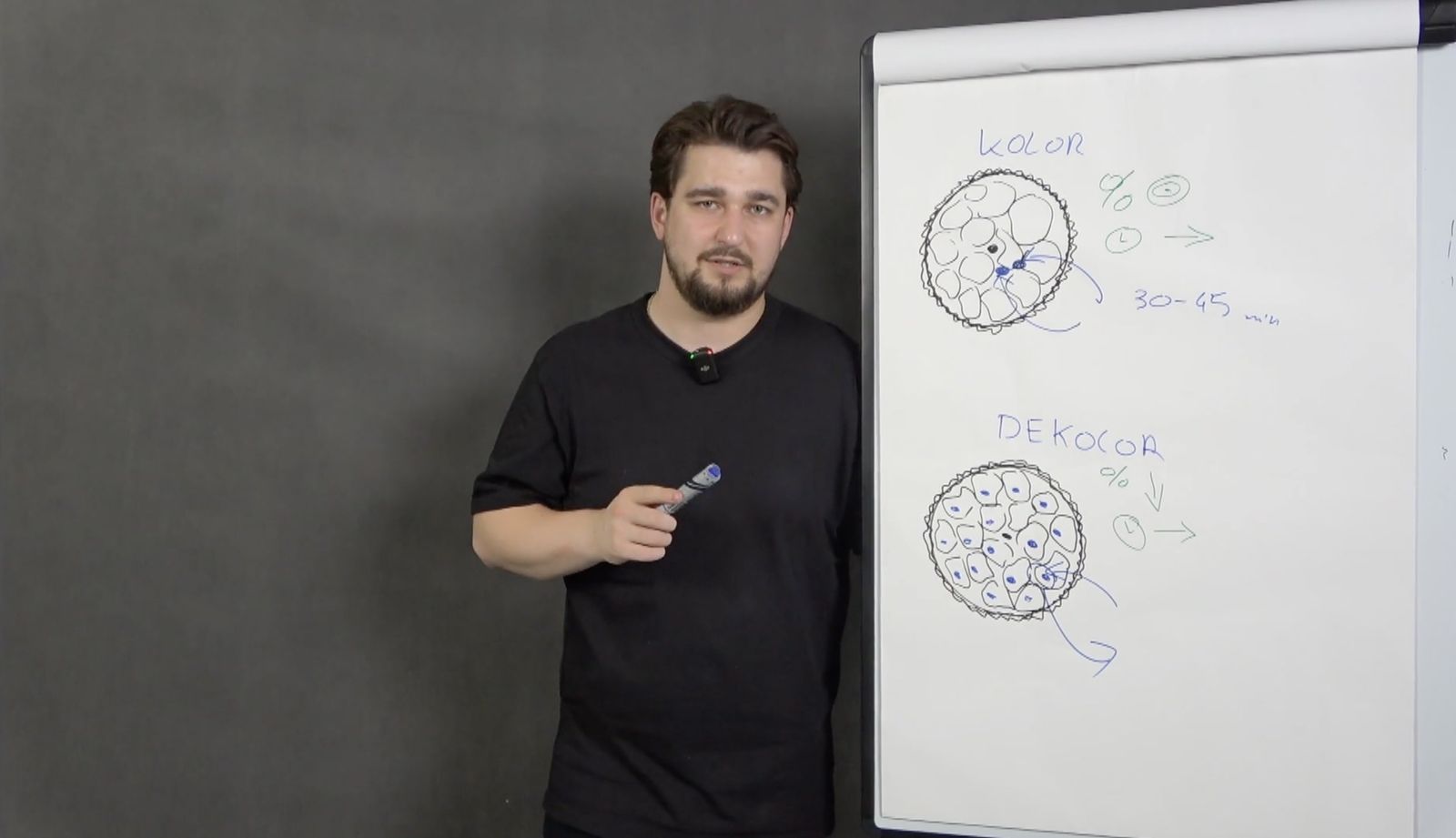
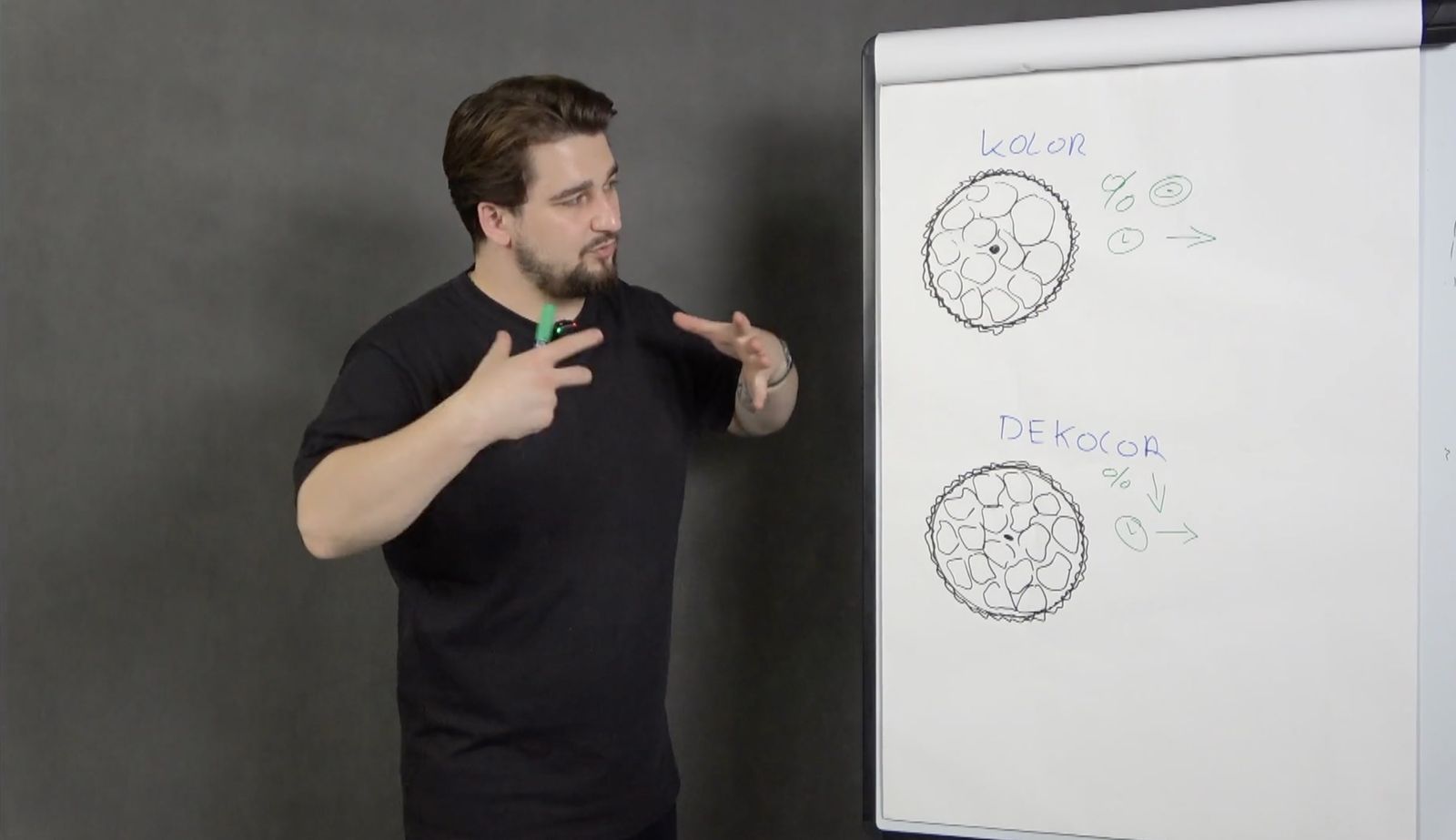
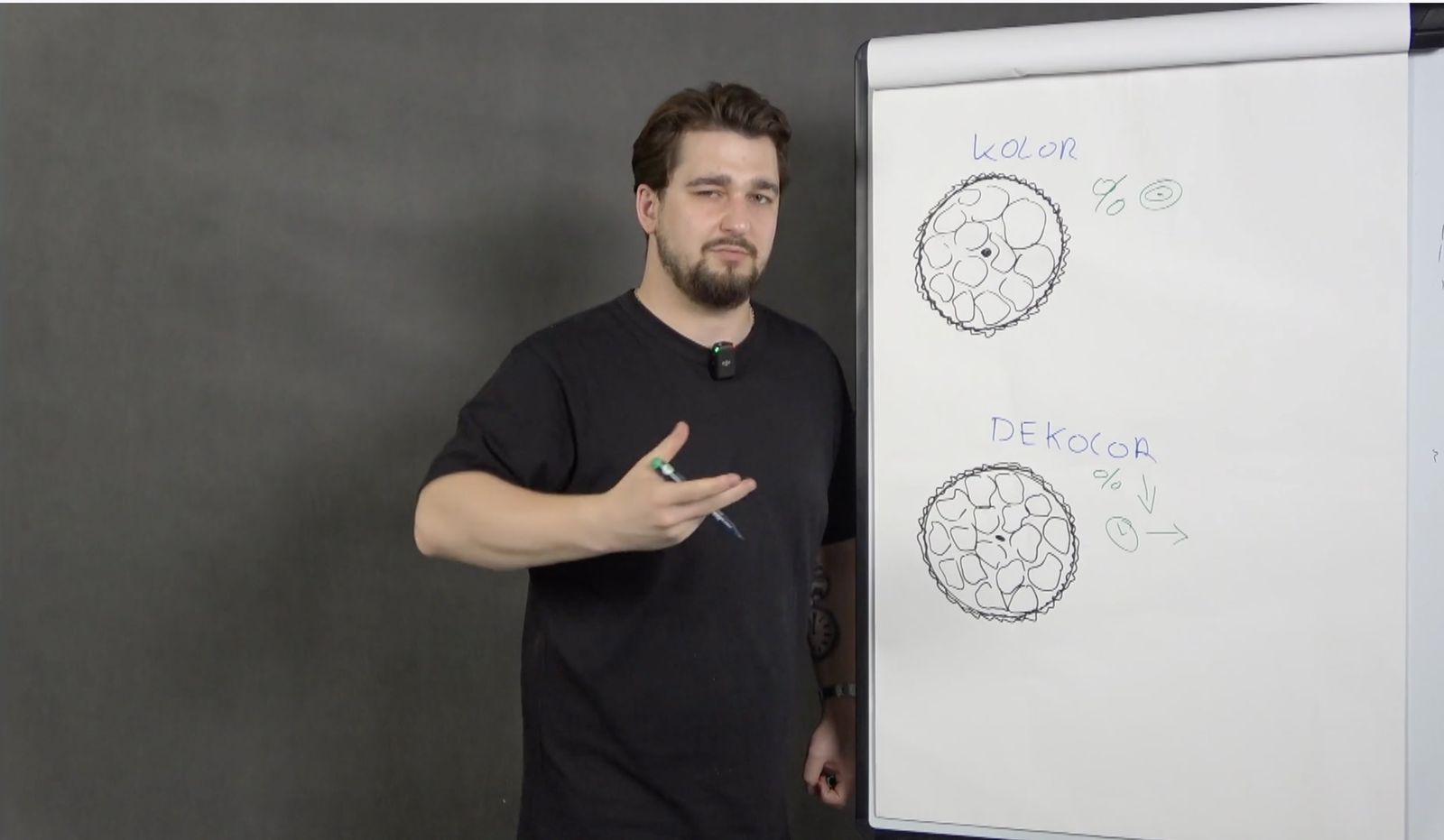
Bartłomiej Lacz walks you through the chemistry and logic of both processes, from hair structure to the action of specific ingredients in the mix. He explains why a low developer and longer decolorization time give a cleaner result than a high concentration used quickly, and when a three-percent developer is enough for full gray coverage. On the flipchart, he visualizes how pigment precursors work in coloring and how ammonium salts work in lightener, giving you the tools to plan your work with intention rather than just replicating formulas.
In this course you'll see
- The real meaning of coverage percentages on color - why 50% coverage won't cover 30% gray hair on the head, and how this knowledge changes your mix selection.
- The principle of working with "fresh lightener" - why mixing small batches every 15-20 minutes is the key to even decolorization from the nape to the crown.
- The technique of adding gold pigment to cool mixes for gray hair, to achieve radiance and saturation rather than a warm tone.
- Why decolorizing henna ends in a green or turquoise reflect, and how it fundamentally differs from stripping oxidative pigments.
- When a 3% developer is enough for 100% gray coverage, and when you need to reach for 9% - diagnosis based on hair structure (glassy vs. matte).
- The difference between the pigment precursor and the actual pigment - how understanding this process helps you avoid insufficient gray hair coverage.
After this course, you'll stop treating decolorization and gray hair coloring as an unpredictable lottery. You'll understand the chemical foundations of both processes, allowing you to work with intention when choosing products, timing, and technique for a specific hair structure and its history. The toughest cases in the salon - from stripping black to stubborn gray hair - will become opportunities to showcase craft built on knowledge, not luck.
What you will learn
- 01How to effectively cover stubborn gray hair even with a 3% developer.
- 02Why a lower developer and longer time give a cleaner decolorization result.
- 03How to work with "fresh lightener" for an even lightening effect.
- 04How to add radiance to cool colors on gray hair using gold pigment.
- 05How to interpret the gray coverage percentages listed on color packaging.
- 06How pigment precursors and ammonium salts work in the coloring process.
Before you start
This course assumes you already have:
What's inside
Full access with the course 4:10
4:1001Cool color on gray hair
A very cool color will definitely give me a more intense result in terms of color saturation.
 5:39
5:3902Choosing developer for hair structure
You don't always need to reach for a high developer - many hair structures will cover even with a 3% developer.
 8:01
8:0103Gold pigment in cool coloring
It's worth adding a touch of, for example, gold pigment to a mix like this.
 12:14
12:1404Staged application and rinsing off lightener
We can apply part of it, rinse part off, and keep applying the rest.
 19:12
19:1205Coloring chemistry - pigment precursor
The first part is called the pigment precursor, which initially penetrates into the hair.
 21:00
21:0006Unusual results when lightening henna
In the case of henna, the hair lightens through brown to green, to turquoise-blue.
 22:12
22:1207Key rule - always fresh lightener
I have to keep working with fresh lightener the whole time.
 26:07
26:0708The role of consultation in difficult cases
One thing we can always do is find out as much as possible during the consultation.
FAQ
Is this course for beginners or experienced hairdressers?
Does the course cover work on natural or colored hair?
Will I learn why a high developer for decolorization isn't always a good idea?
Does the course explain how to avoid a flat, dull color on gray hair?
Is this course just theory, or does it also show practice on a model?
What specific products do I need for the techniques in the course?
How long is this course?
Details
Educator

Bartłomiej Lacz
Educator · 5 courses
Schwarzkopf Professional expert and co-founder of Akademia Mąż Fryzjerki, specializing in color techniques. His educational philosophy is that hairdressing knowledge doesn't have to be complicated if it's explained well. That's why in his courses he breaks down complex processes into first principles, covering the fundamentals - from the color wheel to precise diagnosis and client consultation.
Ready for the next level
Unlock full access to the Connected Hair course library.
Join the Academy