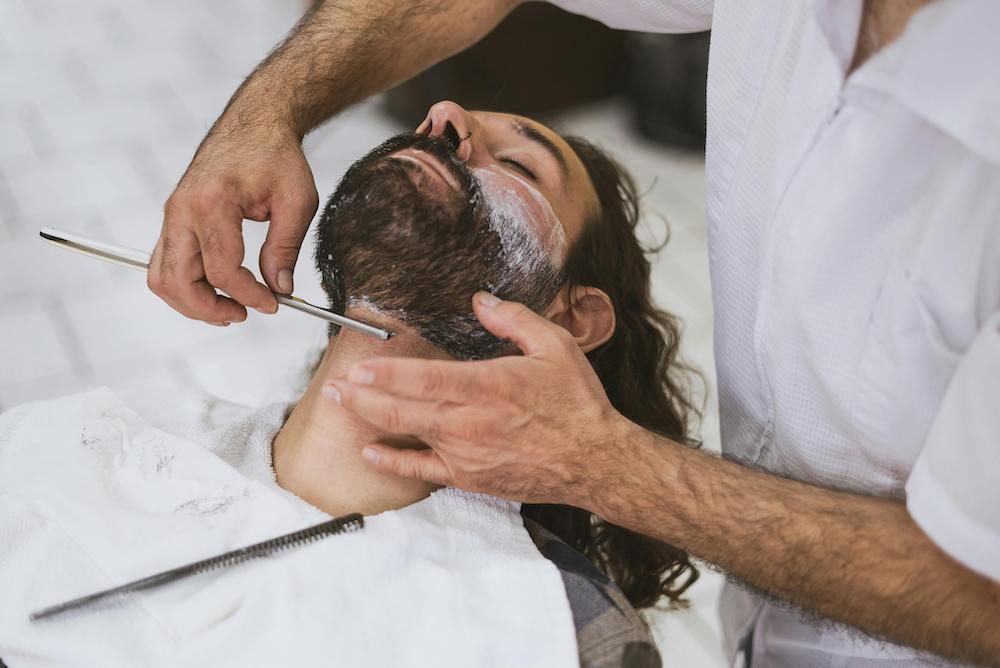
Beard grooming behind the chair is a separate service, not an add-on to a haircut. The client pays for a clean line-up, even transitions, healthy skin beneath the beard, and a shape tailored to the face's oval. Below is a practical breakdown of the work: from identifying beard type, through trimmer and scissor technique, to finishing and solving the typical problems clients bring to the chair.
Identifying Beard Type Before You Start
Beard Types and What They Mean for Cutting
Just like hair on the head, beard growth varies in texture, density, and growth direction. These three traits determine the technique you choose — not the client's preference. Before you pick up the clippers, assess the beard dry and in good light.
- Texture. Straight beard hair lies predictably, so every unevenness in the line-up shows. Curly, coarse beard hair masks length mistakes, but it's easier to cut too short, since it curls up after cutting and looks longer than it actually is.
- Density. Dense growth holds a line well and allows for a sharp line-up. Sparse growth needs more length left on and a softer transition, since a hard line will expose the gaps underneath.
- Growth direction. On the cheeks and under the jaw, hair rarely grows in just one direction. Map the whorls and direction changes with your fingers before you start — these are what create the so-called patchy spots you'll later need to disguise with styling.
Go deeper: we cover the characteristics of different beard types and working with long beards step by step in the course “Cutting and Trimming Long Beards“.
Growth Phases Worth Knowing for Consultations
When a client complains about sparse or uneven growth, it's often a growth stage, not a flaw. Hair goes through three phases, and each one explains what you can expect from the beard:
- Anagen phase (growth) — the hair is actively growing; this is when the target length is determined.
- Catagen phase (transition) — growth slows down and the follicle shrinks.
- Telogen phase (resting) — the hair stops growing and eventually sheds, making room for a new one.
Fun fact: beard hair grows at an average of about 0.4 mm a day — that's over a centimeter a month. That's useful information when booking a client for regular touch-ups: the cheek line-up drifts faster than clients notice.
Hygiene and Skin Prep Beneath the Beard
Washing the Beard
The skin beneath a dense beard collects sebum, dead skin cells, and product residue. It's the skin, not the hair itself, that's behind the itching, dandruff, and irritation clients complain about. The at-home advice you give behind the chair is part of the service:
- A dedicated beard shampoo, not a hair shampoo — it has a gentler pH and doesn't dry out the beard as much.
- Washing 2-3 times a week. Daily shampooing strips the lipid barrier and worsens dandruff.
- Lukewarm water, not hot. Hot water dilates blood vessels and dries out the skin, which intensifies itching.
Go deeper: we break down precision line-up techniques and tool selection in the article “How to Create a Perfect Beard Line-Up: Techniques and Tools“.
Conditioning and Softening the Beard
A hydrated beard is soft, easier to style, and less scratchy. From a barber's perspective, it's also material that responds better to combing and cutting. Three habits worth recommending to clients:
- Beard conditioner after every wash — it restores what water and shampoo strip away.
- Beard oil daily, massaged into the skin, not just the ends — oil works at the follicle level and reduces dandruff.
- Balm or wax for longer beards, when the client needs the shape to hold all day.
Go deeper: we demonstrate product application and the full grooming routine in the course “Professional Facial Care“.
Cutting and Shaping the Beard Behind the Chair
Prep and Work Order
Cut the beard dry and combed through. Wet hair stretches and turns out shorter than intended once it dries, so save any dampening for the finishing stage. Work through a consistent sequence to avoid losing symmetry:
- Comb through the whole beard in the direction of growth, then against it, to see the real density and unevenness.
- Start with the longest guard — you can always go shorter, never longer. Take off the overall length first, then work down.
- Work in sections and check both sides of the face in the mirror every few passes. It's easier to maintain symmetry incrementally than to fix it at the end.
Trimmer: Angles, Guards, and Transitions
Clippers guided flat, with the full length of the blade against the skin, cut evenly. The most common mistake is working with just the tip of the trimmer at an angle, which creates steps. Key rules:
- Cutting against the grain. Cut opposite to the direction of growth, blade flat against the face. Under the jaw and on the neck, hair grows in different directions, so adjust the angle of your hand, not the angle of the clippers against the skin.
- Guard graduation. Longest on the chin and under the jaw, shorter on the cheeks, shortest near the ear and sideburns. Dropping one guard number per zone gives you natural graduation without a hard line.
- Transition (beard fade). Where the sideburns meet the hair and near the ear, blend the boundary with a fanning motion, tilting the clippers away from the skin during the pass. It's the same guard graduation as a fade on the head, just on a smaller area.
- Neckline. Set it two fingers above the Adam's apple, in an arc from ear to ear. Too high exposes the neck and ages the face; too low, and the beard blends into chest hair.
Go deeper: we break down blending the beard line-up with the haircut, and the transition itself, in the course “Burst Fade“.
Scissors and Comb: Length Control
The trimmer removes weight, but scissors give the beard its shape and soft ends. The scissor-over-comb technique lets you precisely catch individual longer hairs without cutting into the overall length:
- Lift the section with the comb at a consistent angle and cut whatever extends past the teeth. A consistent comb angle guarantees even length.
- Use the tips of the scissors (point cutting) to thin out the edge of a long beard, avoiding the look of a flat-cut brush.
- Trim the mustache with scissors over a comb held horizontally above the lip — a trimmer can easily take off too much here.
Combing and Setting the Shape
Combing isn't just about tidying up — it's a cutting and styling tool. The choice of accessory depends on length:
- A natural-bristle brush for shorter beards — it distributes oil, lays the hair down, and adds visual density.
- A wide-toothed comb for longer beards — it detangles without pulling and lets you lift the section for cutting.
- Comb after applying oil or balm — the product spreads evenly and the shape holds longer.
Fun fact: regular brushing stimulates circulation in the skin and distributes sebum along the hair, keeping the beard in better condition.
Advanced Treatments for Beard and Skin
Facial Massage
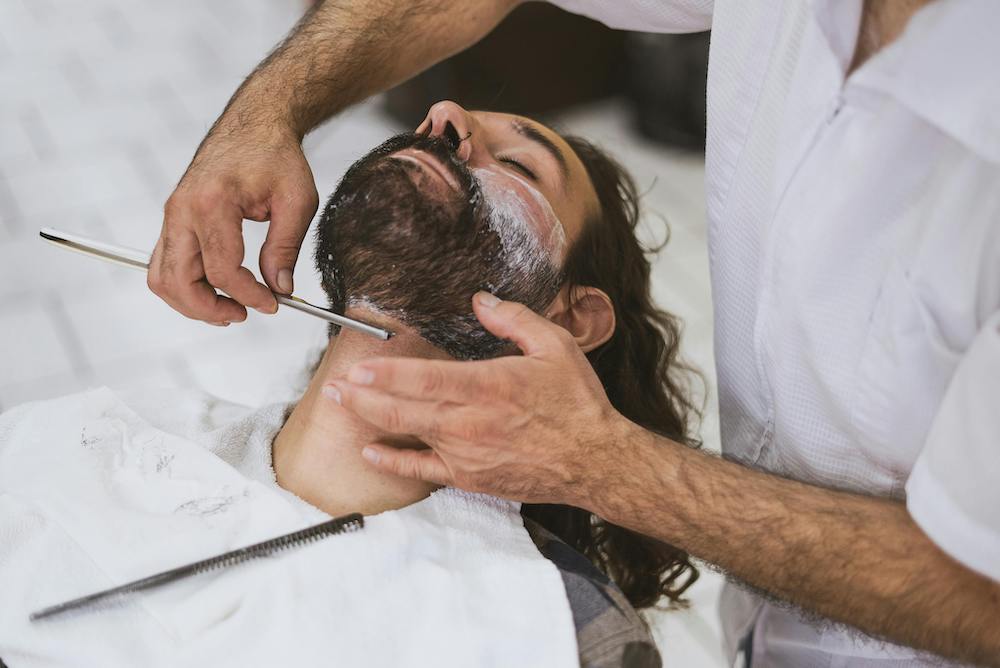
Facial massage improves blood flow to the skin beneath the beard and is a natural complement to a salon beard-grooming service. Guidelines to pass on to clients for their home routine:
- 5-10 minutes, using circular motions with the fingertips, without pulling on the beard.
- Best done with beard oil, which reduces friction while nourishing the skin.
- With extra focus on areas of weaker growth, where improved circulation makes a real difference.
Go deeper: we demonstrate professional massage techniques you can offer as a standalone service in the course “Professional Face and Shoulder Massage“.
Exfoliants and Masks
Exfoliating beneath the beard removes dead skin that clogs follicle openings and worsens beard dandruff. It's a treatment worth working into skin prep before cutting, or recommending to clients at home:
- A gentle exfoliant once a week, massaged in against the grain, down to the skin.
- A hydrating mask every two weeks, when the skin is dried out from washing and wind.
- Products free of irritating ingredients — the skin under the beard is more prone to irritation than the rest of the face.
The Most Common Client Problems and How to Solve Them
Itching and Dandruff
Itching and dandruff are the most common complaint in the first few weeks of growing out a beard, when freshly cut ends poke the skin and it's already dry. Action plan:
- Increase skin and beard hydration — oil daily, massaged into the skin, not just the ends.
- For persistent dandruff, reach for a dedicated anti-dandruff beard shampoo instead of a regular one.
- Advise against hot showers and aggressive towel-drying, which dry out the skin further.
Go deeper: we cover working with weaker growth and optically thickening it in the article “Men's Hairstyles for Thin Hair: Tricks and Tips“.
Uneven Growth and Patchy Spots
Patchy cheeks and uneven density are the most common reasons clients give up on growing a beard. The barber's job is to design a shape that works with what the client has, not what they don't:
- Leave more length in denser areas — longer hair lies down and covers the gaps nearby.
- Lower the cheek line if it exposes weak growth. Sometimes a lower, softer line looks fuller than a high, sharp one.
- For very uneven growth, suggest a shorter, uniform beard or heavy stubble instead of a full beard — a shape that doesn't put patchy spots on display.
- Set the client's expectations for patience: some areas fill in later, and judging the beard too early often ends with shaving off perfectly healthy growth.
What to Recommend to Clients Beyond the Chair
Diet That Supports Beard Condition
You can't change beard growth with scissors, but you can point clients toward things they actually have control over. Hair condition depends partly on nutrition:
- Protein (eggs, fish, nuts) — hair is built from keratin, which is a protein.
- Vitamins A, C, and E, which support the skin and follicles.
- Proper hydration — dehydrated skin means more brittle hair.
Fun fact: biotin, often called the beauty vitamin, is sometimes recommended to support hair growth and strength.
Stress and Sleep
Stress and lack of sleep show up in the skin and the hair growth cycle. Three recommendations that fit naturally into chairside conversation:
- Regular exercise to reduce stress.
- 7-8 hours of sleep, during which the skin regenerates.
- Relaxation techniques, if the client lives under constant tension.
Go deeper: we discuss the impact of lifestyle on appearance in the podcast “On Things Forgotten and Pushed Aside“.
Trends Worth Having in Your Offer
Natural and Organic Products
Clients are asking about the ingredients in beard products more and more often. It's worth knowing this category, since it's a sales argument in the salon:
- Certified organic products as an answer to that demand.
- Paraben- and silicone-free formulas for sensitive skin.
- Awareness that natural doesn't always mean better — what matters is matching the product to the client's skin type.
Personalizing the Service
Clients don't want a one-size-fits-all approach — they want a shape tailored to their face and grooming suited to their own beard. That's the salon's edge over a home trimmer:
- A consultation that matches the shape to the face's oval, jawline, and beard density.
- Recommending specific products for the client's skin type, not a one-size-fits-all set.
- A plan for regular touch-ups, since the cheek line-up and neckline drift out of shape fastest.
Go deeper: we've rounded up the current directions in men's haircutting in the article “Top 10 Men's Haircutting Techniques“.
Key Takeaways
A great beard starts with identifying the growth and ends with a clean line-up and transition. Cut dry, work down from the longest guard, keep the clippers flat against the skin, build the shape with scissors, and design the neckline and cheek line for the client's face, not a template. The skin beneath the beard is the foundation — without proper hygiene, even the best cut looks weak.
Beard technique is a skill of its own, worth developing just as much as haircutting. For more practical resources, check out our blog and our course offering.
See it in practice: in the beard cutting and trimming course you'll follow the entire process step by step on a model, with commentary from the instructor.