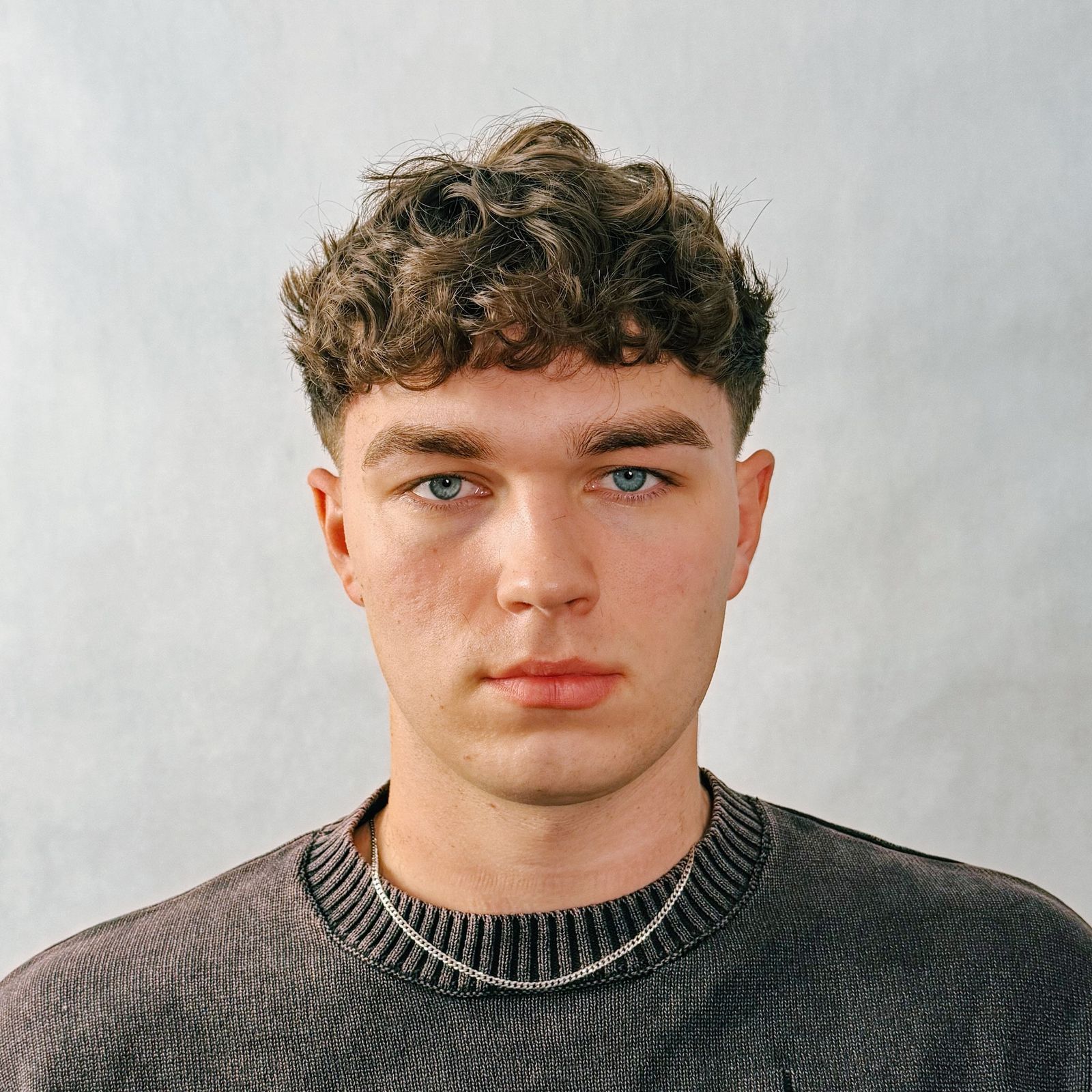
The quiff is one of the few haircuts that love hair with character. If yours stands up, lifts, and won't lie flat even after washing, that's not a problem to tame — it's the raw material this haircut draws its strength from. The more your hair wants to stand up, the better the quiff works on it.
The quiff is a men's haircut with a long, lifted fringe combed up and back, most often paired with a fade on the sides. Its shape is built on two simple rules: vertically, you build a triangle where the fringe is the longest element, and horizontally, a square so the top doesn't narrow into a mohawk. The rest is choosing the right fade for the hair's structure and colour.
Quiff vs. Mohawk and Round Shapes: Where Shape Mistakes Come From
What sets the quiff apart from a mohawk and a round shape is a wide, square shape across the top instead of a narrow strip down the middle of the head or a rounded weight of hair. The most common mistake when building this haircut is ending up with a triangle or a circle instead of a square across the top. That turns the quiff into a mohawk or a soft, rounded shape that loses that character entirely.
Horizontally, the quiff has to be square, and vertically it needs to keep the triangle with the fringe as the longest point. These two geometries together create the recognisable shape. When a circle forms vertically instead of a triangle, the fringe ends up shorter than the hair behind it, and once the style is up, the hair at the back sticks up higher than the fringe — which looks wrong.
Clients don't pay us for how much hair falls on the floor — they pay for the result they walk out with.
Miłosz Mikołajczak
Who Is the Quiff For
The quiff works best on hair with a stiff, upright structure that already tends to lift on its own. That kind of hair doesn't respond well to combing down and smoothing, because the client won't be able to keep it in check day to day. The quiff goes the other way: it uses the hair's natural tendency to stand up and turns it into an advantage.
A good head shape helps too: a nicely rounded occipital area and a crown that hasn't been flattened out are an asset that Miłosz Mikołajczak tries to preserve rather than cancel out. That's why he prefers to leave the hair slightly longer at the back, to fill out the nape area instead of flattening that part of the head. For him, a proper consultation beforehand — checking which way the hair grows and what it will allow — is a condition for a good cut.
How the Quiff Is Built, Step by Step
The quiff is built from the top down — the shape at the crown comes first, and the fade is chosen to match it afterwards. Here, the fade is an addition that highlights the shape, not the main event of the cut. That's why the work actively starts with what's right at the top.
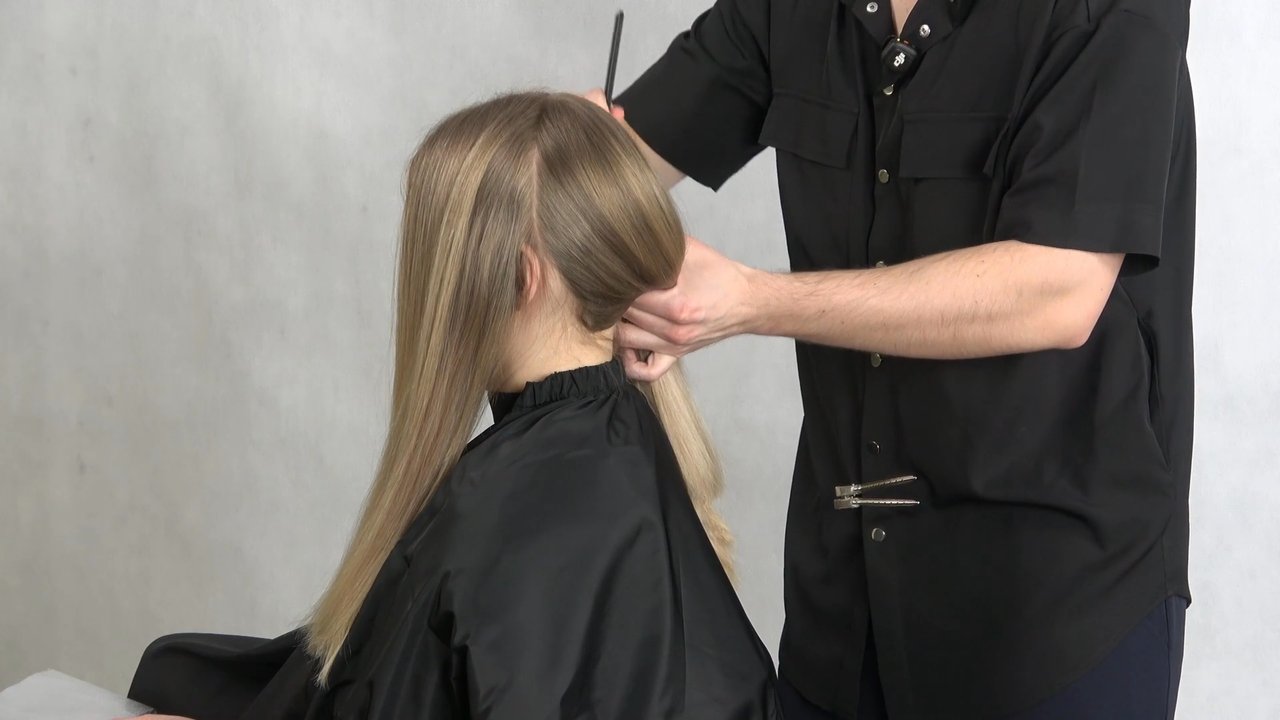
The sectioning is simple: one large top section, with a back panel including the crown sectioned off separately. You can run this parting line not along the curve of the head, but along the natural growth pattern — from the whorl toward the mastoid processes — so that hair that falls forward goes forward, and hair that falls back stays back. The process on top itself looks like this:
- The first separation at the very top of the head, at the centre, as the shortest and highest point of the haircut.
- Checking the length and building the vertical triangle: the fringe stays practically untouched as the longest element, with the most hair coming off in the crown area.
- Cutting from the fringe backward, with the section redirected slightly back to build the square.
- Carrying the length over into the horizontal shape: sections combed horizontally, comb held parallel to the ceiling.
- Point cutting on the following sections to add texture straight away while keeping the square outline.
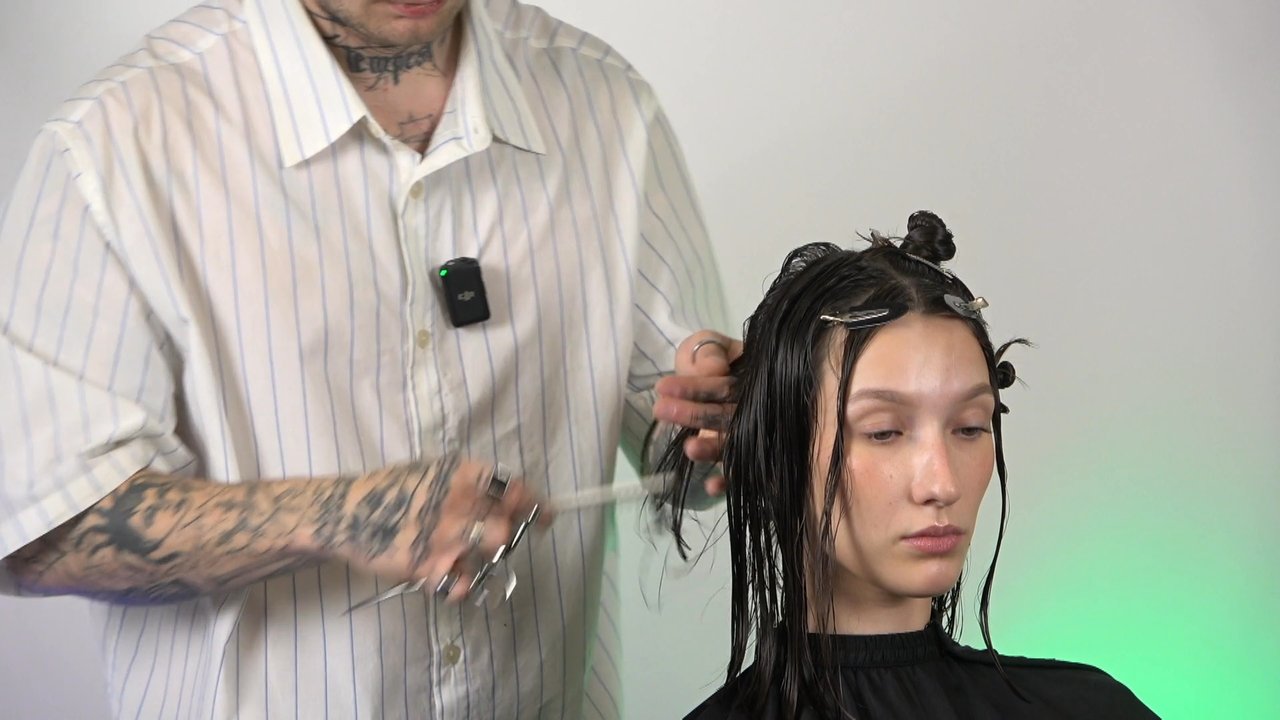
The most important rule for building the horizontal square is comb position: it has to stay parallel to the ceiling, no matter how the head is tilted. The horizon line is set wherever the client's eyes are looking. Watch Miłosz Mikołajczak explain the square rule that the entire top of the quiff is built on:
This one comb held flat to the ceiling is what governs the cut and keeps the top from drifting into a triangle or a circle. That's what keeps the fringe as the longest point, with the hair behind it never coming up higher than the fringe — which would look wrong once the style is up.
Fade to Match the Shape: Two Techniques
The sides of the quiff are most often finished with a fade, running from a shorter, lighter section at the bottom to a longer, darker one at the top. Miłosz Mikołajczak demonstrates two different techniques for reaching that result on a single model, one on each side of the head.
The first is descending — a step-down technique: you start with the highest guard and work your way down through consecutive lengths, working on a closed blade. It works well on light, thin hair. The second is guard skipping: you set the top baseline and the bottom zero line first, then fill the area between them with successive lines, which you blend afterwards. This technique works better on dark, thick hair, because the lines are easier to see. Watch how the middle line is introduced with the guard-skipping technique:
Once the lines are set, the whole trick is blending them out — working through successive guards using wrist movement, not the shoulder. The wider the area between the top and bottom lines, the smoother the fade turns out, so it's better to set the zero low and stretch out the transition than bunch it all in one spot. Both techniques can be brought to the same, consistent result, so the choice comes down to the client's hair structure and colour. These are the same rules that govern every well-blended fade.
Styling the Quiff
The quiff is styled so the fringe is combed out wide and lifted, in line with the square shape built during the cut. The goal here isn't to flatten the top or narrow it into a triangle. All the work during blow-drying goes toward volume and lift at the root.
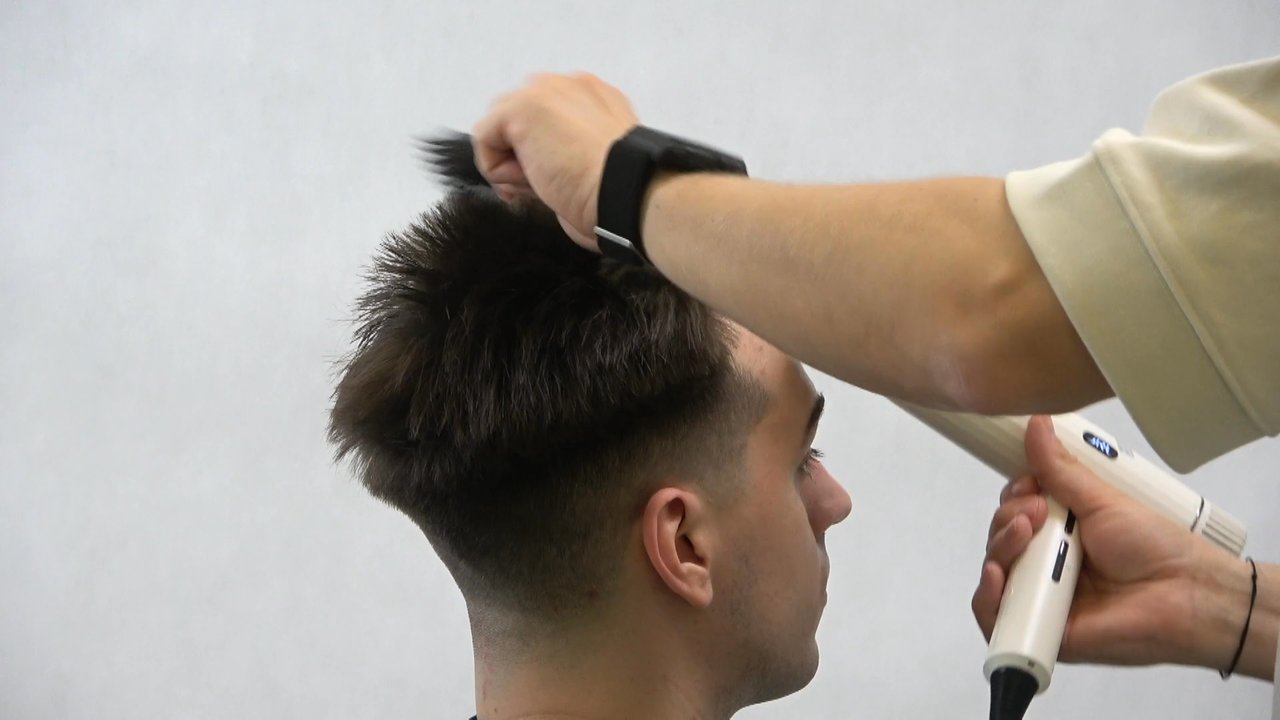
The trick for volume is drying in the opposite direction to the final style. Miłosz Mikołajczak dries the quiff almost like a pompadour, back and away from the face, leaving the hair slightly damp, and only styles it forward at the very end. This makes the hair lift off the root and gain fullness, which gives a strong result on stiff hair. See this pro tip in action:
For finishing, a matte paste or powder works well, and for stronger hold, you can also blast hairspray into the dryer's airflow, section by section. Whether the quiff ends up more classic and polished or modern and heavily textured largely comes down to the styling itself. If you like that choppy, spiky aesthetic, the messy taper follows a similar path.
If your quiff keeps coming out flat on top, or the fringe disappears under the hair at the back, it comes down to the square-and-triangle geometry in the cut. Miłosz Mikołajczak walks through the entire cut step by step in the Quiff course: how to build the square shape with the comb held parallel to the ceiling, when to choose descending versus guard skipping for the fade, and how to blow-dry the style for full volume.