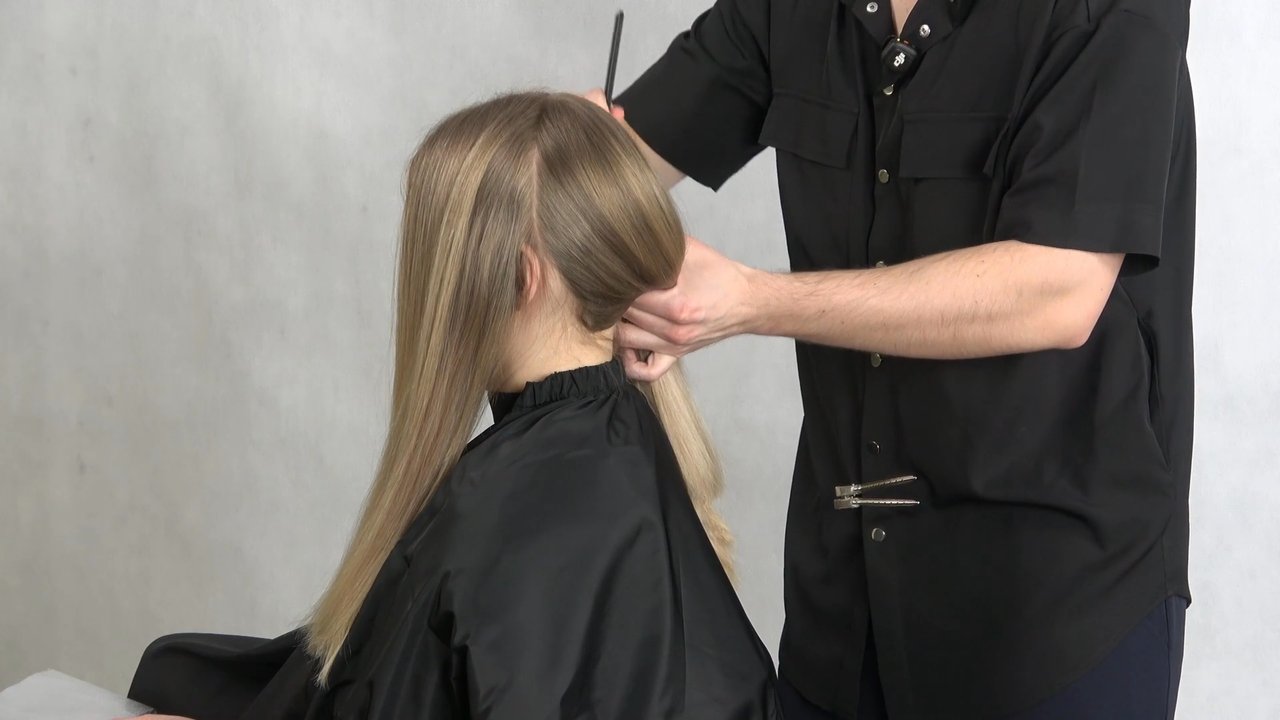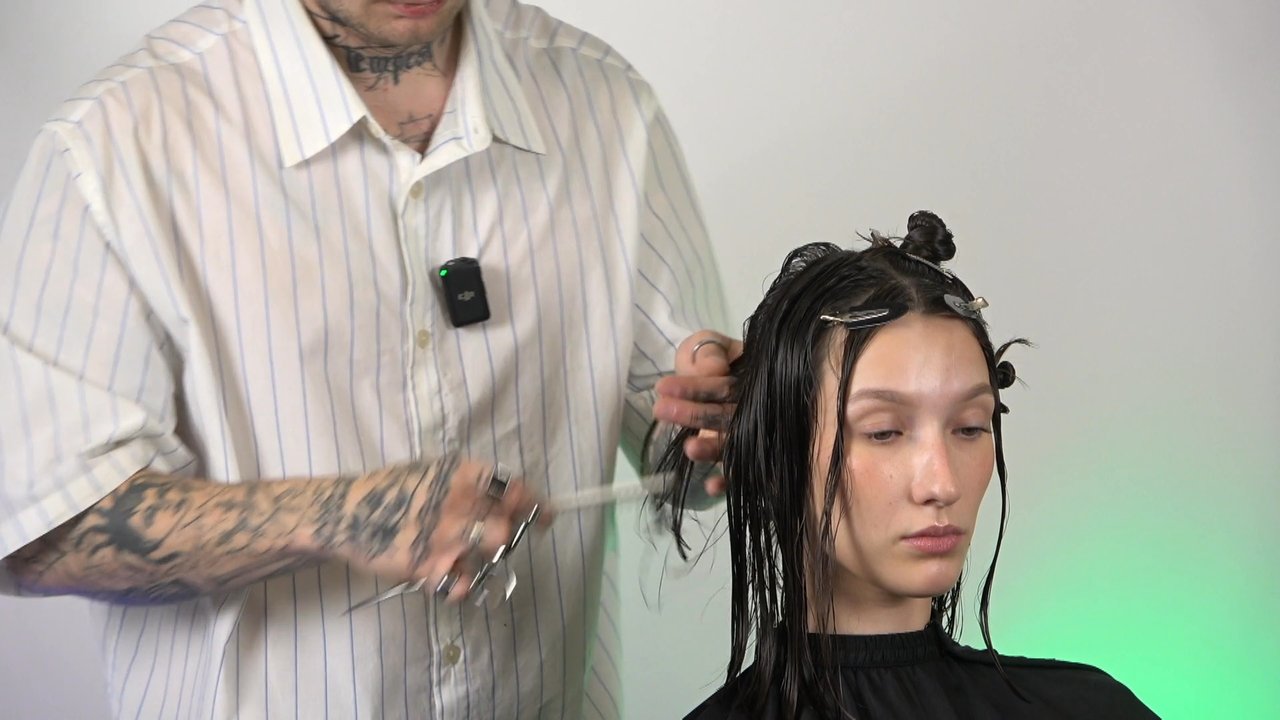
Hair that lies flat on the shoulders like a pancake isn't a matter of length — it's about how the weight is distributed. Italian Bob flips this logic: it builds weight and contour at the bottom, while removing weight up top so the style lifts and curls under on its own.
Italian Bob is a bob roughly collar-length, a touch shorter than shoulder-length, where the bottom is cut using the line technique for weight and contour, and the top is cut in square layers to add volume and lightness. The result is a style with movement, slightly turned under, with a very short curtain fringe that frames the face but practically disappears when styled back. It's a cut for anyone who wants shape and volume without a radical cut in length.
How Italian Bob differs from a classic bob
Italian Bob differs from a classic bob in that it's not one uniform, heavy line — instead it combines a strong bottom with a layered, weight-reduced top. In a classic bob, all the weight sits on one plane and the hair often falls flat. Here, Paweł Rup leaves the weight under the occipital bone, then removes weight higher up with layers so the crown lifts.
This distinction is key when choosing the right cut. Italian Bob is often confused with an ordinary shoulder-length bob. The difference is that it's designed from the start for volume and movement, not for a smooth, uniform line. If you're after another unisex cut with movement, check out the wolf cut too.
We don't want that pancake effect in this hair. We want everything to lift up nicely, to have something happening up here.
Paweł Rup
Who is Italian Bob for
Italian Bob works best for anyone who wants hair a little shorter than shoulder-length, with more volume, without cutting off a lot of length. In the course, the model asks for exactly that: a bit shorter than shoulder-length and more volume, without a drastic cut. That's the starting point for the whole style.
The cut works beautifully with hair that starts to curl and turn under nicely on its own as you work. The curtain fringe and slightly longer pieces toward the face create face framing — softening and framing the features around the face.
How Italian Bob is created step by step
Italian Bob is created by dividing the head into zones, where the bottom is cut in a line at zero-degree projection, and the top and sides are cut in square layers at ninety degrees from the head's plane. Paweł Rup starts at the back and sections the hair based on the occipital bone: everything below it builds weight and is cut in a line, while the upper occipital area gets layered for lightness.
The workflow breaks down like this:
- The side section is separated at the head's break point, to build the bob effect at the bottom.
- The back section is divided based on the occipital bone: the bottom for weight, the top for volume.
- A very short fringe is sectioned off at the front, also cut in layers.
- Work is always done on wet hair, since it cuts better at the correct projection that way.
In the lower occipital area, Paweł works in a line but introduces disconnection into it: he cuts the first separation at one length, the next one at a slightly different length, to build a nice rounded shape over the whole section. Instead of cutting each strand exactly to the guide underneath, he leaves a little extra space so the hair rounds out over the previous separation. This creates a horizontally rounded shape instead of a hard, straight line.
Watch how Paweł leaves this extra space with the point cut, instead of dropping exactly to the guide:
This small margin determines whether the bottom of the style ends up as a flat, dead line or a softly rounded shape that works with the rest of the cut.
Square layer and volume on top
The top of the style is cut in square layers, at ninety-degree projection, to preserve length while adding lightness and volume. Here Paweł carries length up from beneath the occipital bone, working along the axis of symmetry of the section, where the two strands meet. This way he replicates the plane of the head, instead of narrowing the shape.
On the sides, the same logic works on width. Paweł redirects each successive section within the square — section one to two, two to three — so the style looks wider and has volume when viewed from the front. By removing weight from the interior, he builds width across the whole silhouette.
Watch how this redirection within the square builds width in the style as seen from the front:
This is also where Paweł's signature rule comes in: once the comb is placed at the root and the section is redirected, the comb no longer moves left or right, only forward and back. This gives a repeatable angle and even cutting lines. On straight hair, Paweł works with small sections here and avoids horizontal cutting, which in his view more easily leads to steps.
The curtain fringe that's there and not there
The fringe in Italian Bob is a very short, barely-there curtain fringe, cut at ninety-degree projection from the forehead using the slide-cutting technique. Paweł doesn't shorten the length dramatically here — he simply adds lightness to the front and marks the starting point of the layers around the face. The fringe only begins around the jawline, so it's there and not there at the same time.
Listen to how Paweł explains the idea behind this fringe to the model right at the start:
This solution has a practical advantage: when styled back and to the sides, the fringe disappears, so it doesn't get in the way day to day, yet it frames the face whenever needed. The model can sweep it to either side, or leave a natural parting.
Styling Italian Bob
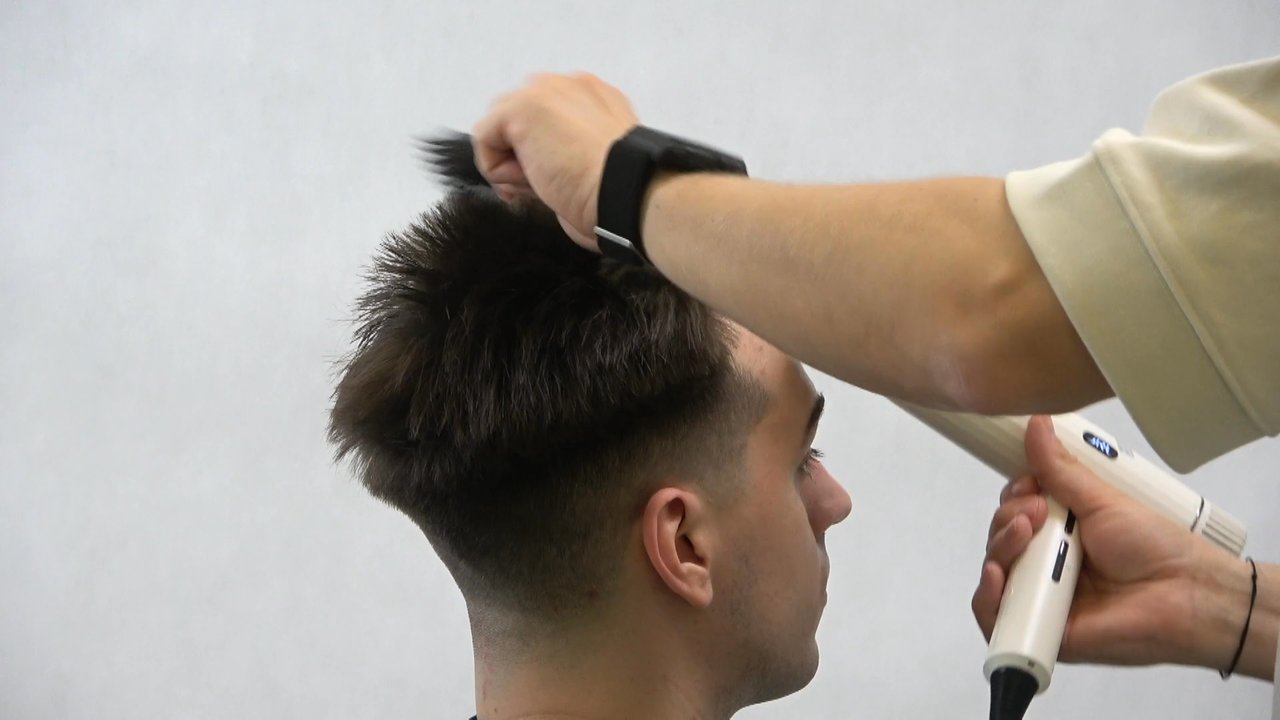
Italian Bob is styled on wet hair with heat protection and a light volumizing spray, then dried in two stages: with a diffuser under the occipital area, and on a round brush higher up. Paweł first rough-dries the hair without a diffuser attachment, then styles it with heat afterward. He applies the volumizing spray from the root, at the right distance, taking care not to overload this loose, everyday style.
When using the round brush, Paweł sticks to three principles: the right styling temperature, tension, and stretching the hair. He wraps the sections irregularly and not along the full length, so the curl looks natural, as if the hair turned under on its own rather than being blow-dried on a brush. At the end, he seals the cuticle with cold air, adds a light hairspray at the roots, and separates the sections with a styling comb so the style stays movable.
How long does Italian Bob last
Italian Bob styles well for as long as the weight distribution stays in place, since the weight is gathered at the bottom while the top is lightened with layers. Because the volume comes from the structure of the cut itself, not just from styling, the hair is easier to style day to day, feels lighter, and turns under on its own. The style is designed as a loose, everyday salon look that's easy to touch up at home.
If your bob lies flat on the shoulders and lacks volume on top, it's a matter of zone division and choosing the right cutting technique. Paweł Rup shows the entire cut step by step in the Italian Bob course: how to build weight in a line under the occipital bone, add volume with square layers on top and sides, and finish the style with a curtain fringe and brush-drying.