Clippers are the tool you work with for several hours a day, sometimes more. Their power, blade geometry, and balance determine whether you'll achieve a clean, seamless fade or end up fighting hair pulling and a second pass over the same section. This guide breaks down what actually matters when buying: drive type, blade, ergonomics, versatility, and service – and how to match your equipment to what you actually cut.
1. Clipper Types: Corded or Cordless
The first decision is power supply. There's no single right answer here – the choice depends on how you work and which services you perform most often.
Corded Clippers
These work best where consistent power without any drop-off matters: cutting through thick, dense hair, long days behind the chair, photoshoot sessions. The blade doesn't slow down mid-cut, making it easier to maintain even cutting across the whole head.
- Consistent power regardless of runtime, no charging needed
- Usually a lighter build, since there's no battery
- Downside: the cord limits movement around the chair and at the nape
Cordless Clippers
These give you full freedom to turn the client's head and work from any angle, which significantly cuts down time on fades and line-ups. They do require discipline, though: keep an eye on the charge level so power doesn't drop mid-service, which leads to uneven cutting.
- Full freedom of movement around the chair, easier work at the nape and temples
- Ability to work mobile, without access to an outlet
- Often quieter operation; the downside is battery management and slightly more weight
In practice: many barbers work with two clippers – a corded one for the main cutting and a cordless one for detailing and line-up work. If you do a lot of precision fades or work on photoshoots, go with the stable power of a corded model. We break down the techniques that require this in the “Burst Fade“ course.
Motor Type
The motor determines the character of the cut: how aggressively the clippers cut through hair and how they handle the resistance of thick, dense hair.
- Magnetic (oscillating) motor – high blade speed, good price-to-performance ratio. Great for fast cutting and fades; can lose torque on very thick, wet hair.
- Rotary motor – high torque, powers confidently through thick, dense hair. Versatile for both cutting at longer lengths and for precision work.
- Pivot-type motor – quiet, cuts well through dense hair, often found in clippers designed for wet cutting and line-up work.
How to choose: if you mainly do men's fades and classic haircuts, a magnetic or rotary motor will give you speed and control. If you work with very thick or curly hair, go with the torque of a rotary motor so you don't pull the hair or leave “steps.”
2. Technical Specs That Make a Difference
Power and Blade Speed
Speed refers to the number of blade strokes per minute – the higher it is, the cleaner the cut and the lower the risk of pulling. Power determines whether that speed holds up under the resistance of dense hair.
- For dense, thick hair, look for clippers with at least 5W of power so the blade doesn't slow down mid-cut
- A speed of at least 5,000 strokes per minute is a reasonable threshold for professional work
- Speed adjustment comes in handy when you switch throughout the day between fine, straight hair and thick, curly hair
Tip: choosing the right clippers always goes hand in hand with technique. We break down how to work with different hair types in the article “Men's Haircutting Techniques: From Classic to Modern“.
Blade: Material, Angle, and Type
The blade is the part you feel most in the cut. Material matters, but so does its setting – whether you're cutting down to zero or leaving a minimal length.
- Stainless steel – durable and corrosion-resistant, the standard in most clippers
- Ceramic – stays cool longer during continuous use, which matters on long days and with clients who have sensitive skin
- Titanium and titanium coatings – lightweight, sharp, and hold an edge well
Also pay attention to the blade type and whether it has lever adjustment (taper lever). This lets you smoothly change the cutting length without switching guards, which is key to building a smooth fade transition. For the shortest line-up and beard line, a trimmer with a zero-gap blade, run edge against the skin, comes in handy as well.
Tip: a sharp, well-set blade cuts cleanly without pulling the hair – just like sharpened scissors. Regardless of material, clean, oil, and align your blades regularly. We cover the same maintenance principles that apply to scissors in the article “The Secrets to Keeping Barber Scissors Sharp“.
3. Ergonomics and Working Comfort
Weight, Balance, and Grip
With a dozen or more haircuts a day, it's not just the weight that matters, but where the center of gravity sits. Well-balanced clippers “sit” naturally in the hand and don't tire your wrist when working overhead or at the nape.
- Aim for a weight under 300g, especially if you work full days
- Check that the body sits naturally in both a pencil grip and a full grip – you'll use both during a fade
- A non-slip surface matters when your hands are damp or covered in talc
Noise and Vibration
Low vibration isn't just about client comfort – it also translates into precision. Clippers that vibrate heavily in your hand make it harder to maintain a straight line-up and leave micro-inconsistencies in the transition.
- Quieter operation creates a calmer atmosphere in the chair, something clients clearly appreciate
- Less vibration means a steadier hand and a cleaner line-up
4. Versatility and Accessories
Length Adjustment
The smoother the adjustment, the easier it is to build transitions without visible lines. The blade lever lets you change length within a single guard, which is the foundation of the “lever play” technique used in fades.
- Blade adjustment lever (taper lever) for smooth graduation without changing guards
- A wide length range – the more “steps” between the shortest and longest setting, the smoother the transition
Tip: the equipment alone won't create the shape for you. We show how to intentionally build volume and head shape through cutting length in the course “Shaping Volume and Form in Men's Haircutting“.
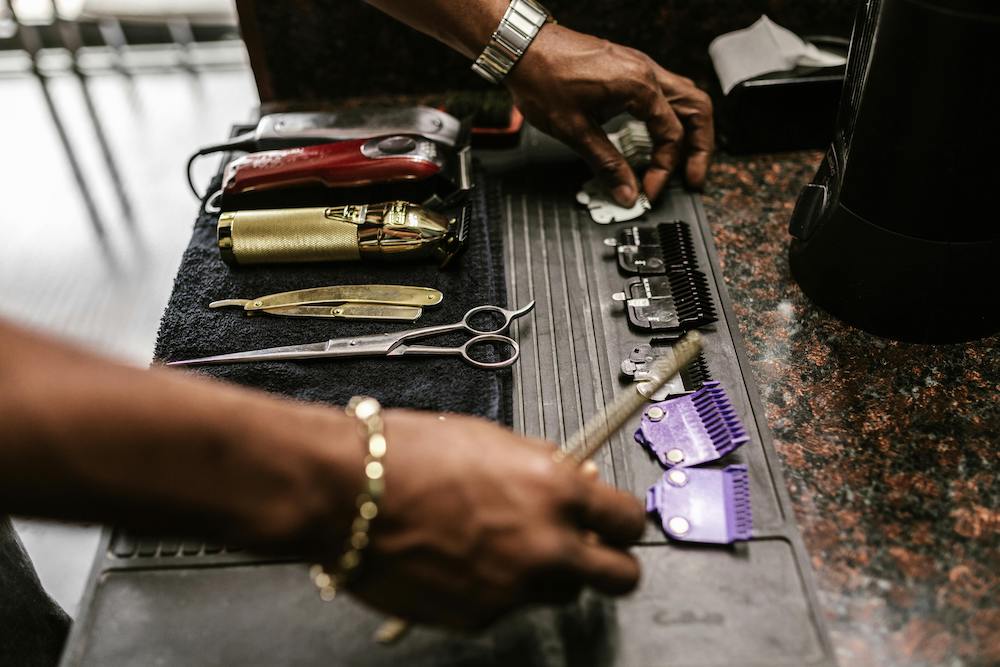
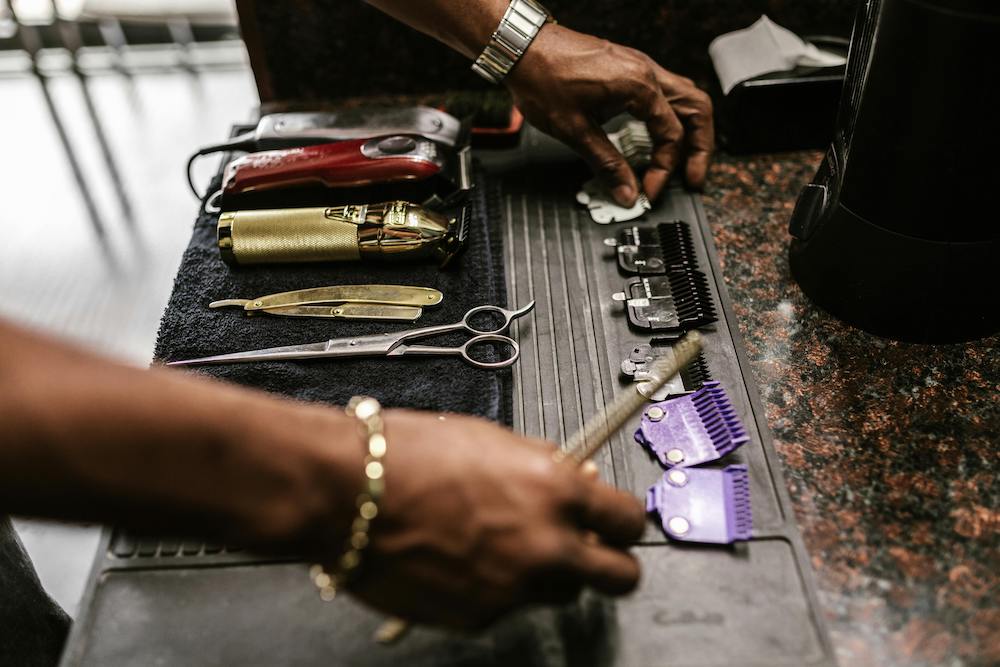
Guards and Starter Kit
A full set of guards is your length grid. In everyday work, most of the action happens on the short end, between guard #0 and #2, which is why their precision matters, along with how securely they attach to the blade.
- A standard set covers guards from roughly 1.5mm to 25mm
- Check how securely they attach – a loose guard “bounces” and ruins even length
- A cleaning brush for the blade and maintenance oil are useful additions to the set
In practice: learn to think in guard numbers (0, 0.5, 1, 1.5, 2), because that's the language you'll use to communicate with clients and recreate a hairstyle at the next visit. For texturizing and opening up the ends on top, you'll still mostly reach for a comb and scissors, so treat clippers as the foundation, not your whole toolkit.
5. Durability, Reliability, and Service
Materials and Build
Clippers that work every day need to withstand drops, vibration, and constant cleaning. A solid body and good internal sealing make the difference between equipment that lasts for years and something you'll replace after a season.
- A body made from durable plastic or aluminum
- Rubber elements that improve grip and dampen vibration
A good pair of clippers is an investment that pays off over years of reliable work. Cheap equipment with a blade that loosens or a motor that weakens quickly starts costing you time and corrections behind the chair.
Warranty and Access to Service
Before buying, check not just the warranty period but also the availability of consumable parts – blades, batteries, guards. Equipment for which you can easily buy a replacement blade will last you much longer.
- Look for a minimum 2-year warranty
- Check access to authorized service and replacement parts
Tip: regular cleaning, oiling, and blade alignment extend the life of your clippers more than any warranty. We talk about tool maintenance – something easy to forget in the daily rush – in the podcast “On Things Forgotten and Pushed Aside“.
6. Price: What to Save On and What Not To
Price-to-Value Ratio
The cheapest clippers are rarely the cheapest over the course of a year. A weaker motor forces a second pass over the same section, a lower-quality blade pulls hair sooner, and the lack of replacement parts shortens the equipment's lifespan. Look at cost over several seasons, not just the price tag.
- Treat clippers as an investment in your craft, not a one-off purchase
- Compare actual specs – power, speed, blade quality, and service – not just the price
Tip: if you're still putting together your first kit, you'll find advice on what to invest in at the start in the article “How to Start a Career as a Barber: A Complete Guide”.
Professional vs. Consumer Equipment
Professional clippers are designed for continuous use: a stronger motor, better blades, available parts and service. Consumer equipment can be attractively priced and is fine for home use, but it usually wears out faster under the daily load of working behind the chair.
- Professional equipment – higher durability, access to parts and technical support
- Consumer equipment – sometimes a reasonable choice for practice or as a backup, rarely for your first chair
The choice between the two isn't just about budget – it's also about how intensively you work and how you want to grow. If cutting hair is your profession, professional equipment pays for itself in comfort and time saved.
7. How to Match Your Clippers to What You Cut
Instead of looking for the “best” clippers, match your equipment to your work profile. A quick cheat sheet:
- Lots of fades and line-ups – a fast blade (magnetic or rotary), a blade adjustment lever, and an additional zero-gap trimmer for lines and beards.
- Thick, dense, or curly hair – go with the torque of a rotary motor so you can cut without pulling and without a second pass.
- Classic haircuts and comb-and-clipper work – smooth length adjustment and secure guards matter, so you can blend evenly with scissor work on top.
- Mobile work or on set – cordless with a spare battery, while for steady, heavy work behind the chair, consider a corded model as your main clipper.
Whatever your approach, it's also worth thinking about the whole salon environment – from station ergonomics to client comfort. We write about how to build a welcoming, modern workspace in the article “The Rise of Gender-Neutral Hairdressing: How to Create an Inclusive Space in Your Salon“.
Summary
The best clippers are the ones that fit your working style and the hair type you cut most often. When buying, go through it step by step: power supply and motor matched to your services, a strong, well-set blade, low weight with good balance, smooth length adjustment, and access to parts and service. Equipment is the foundation, but technique is still what decides the final result.
Want to get the most out of your clippers? Keep developing your craft on our blog and through our course offering – that's where we show the specific techniques where this equipment really shines.