A square face is one of the most rewarding shapes in men's haircutting: a wide, well-defined jawline, strong cheekbones, and a forehead of similar width give you a foundation on which most hairstyles look good almost straight away. The challenge starts when you want to consciously control proportion – softening the angle of the jaw, or conversely, emphasizing it. Below you'll find concrete craft: how to read this face, which shapes to choose, how to cut them with clippers and scissors, and how to finish with styling so the result holds for weeks, not just one evening.
Characteristics of a Square Face
Before you reach for the clippers, analyze the face in the mirror, dry, with the hair combed back to reveal the hairline and the outline of the face. You can recognize a square face by the following features:
- Wide, clearly defined cheekbones
- An angular jawline with a clearly defined angle (gonion)
- A wide forehead, often with a straight hairline
- Similar width at the forehead, cheekbones, and jawline
- Face length close to its width (a ratio of roughly 1:1)
The key to your cutting decisions is the relationship between length and width, and how sharp the jaw angle is. If the face is almost square in outline, you're working to elongate it: building height on top and reducing volume on the sides. If the jaw is strong but the face is a bit longer, you have more freedom and can leave some volume on the sides, since there's no risk of the face looking wider.
The most common mistake is treating the square shape as a single template. In practice, you'll come across a soft variant (rounded angles, more freedom in length) and a sharp variant (a strong gonion, a low hairline). The latter demands discipline: short, tight sides and clear height, because any extra volume at ear level visually widens the face. That's why you analyze each specific client, not work from memory.
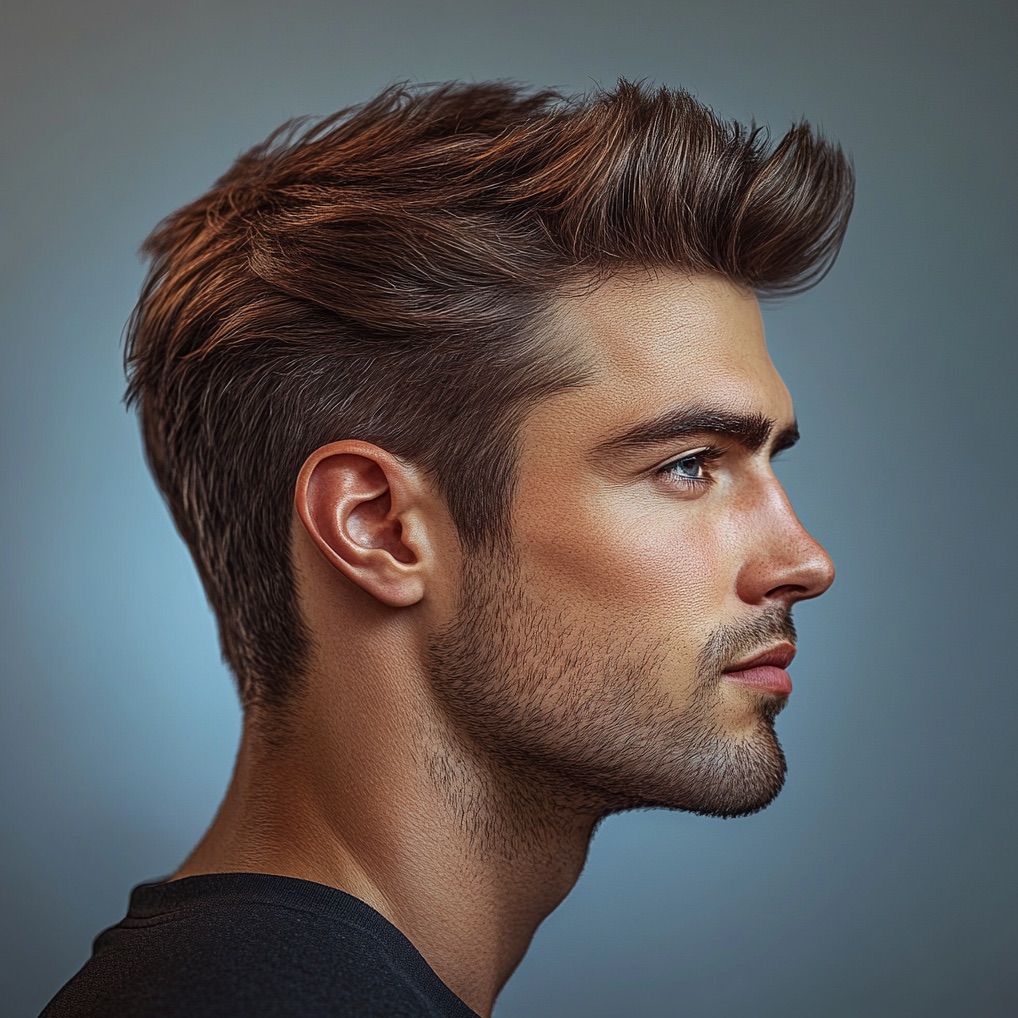
Best Hairstyles for a Square Face
The overarching rule: volume and height go on top, sides stay tight. This pulls the eye vertically and balances a wide jawline. Below is a rundown of shapes that work best on a square face, along with the hair type each shape suits best:
| Hairstyle | Description | Benefits | Ideal hair type |
|---|---|---|---|
| Textured quiff | Longer top styled up and slightly back, shorter sides with a fade | Builds height, texture breaks up sharp features | Medium to thick |
| Pompadour | A classic wave swept back with strong volume at the root | Clearly elongates the face, adds elegance | Medium to thick |
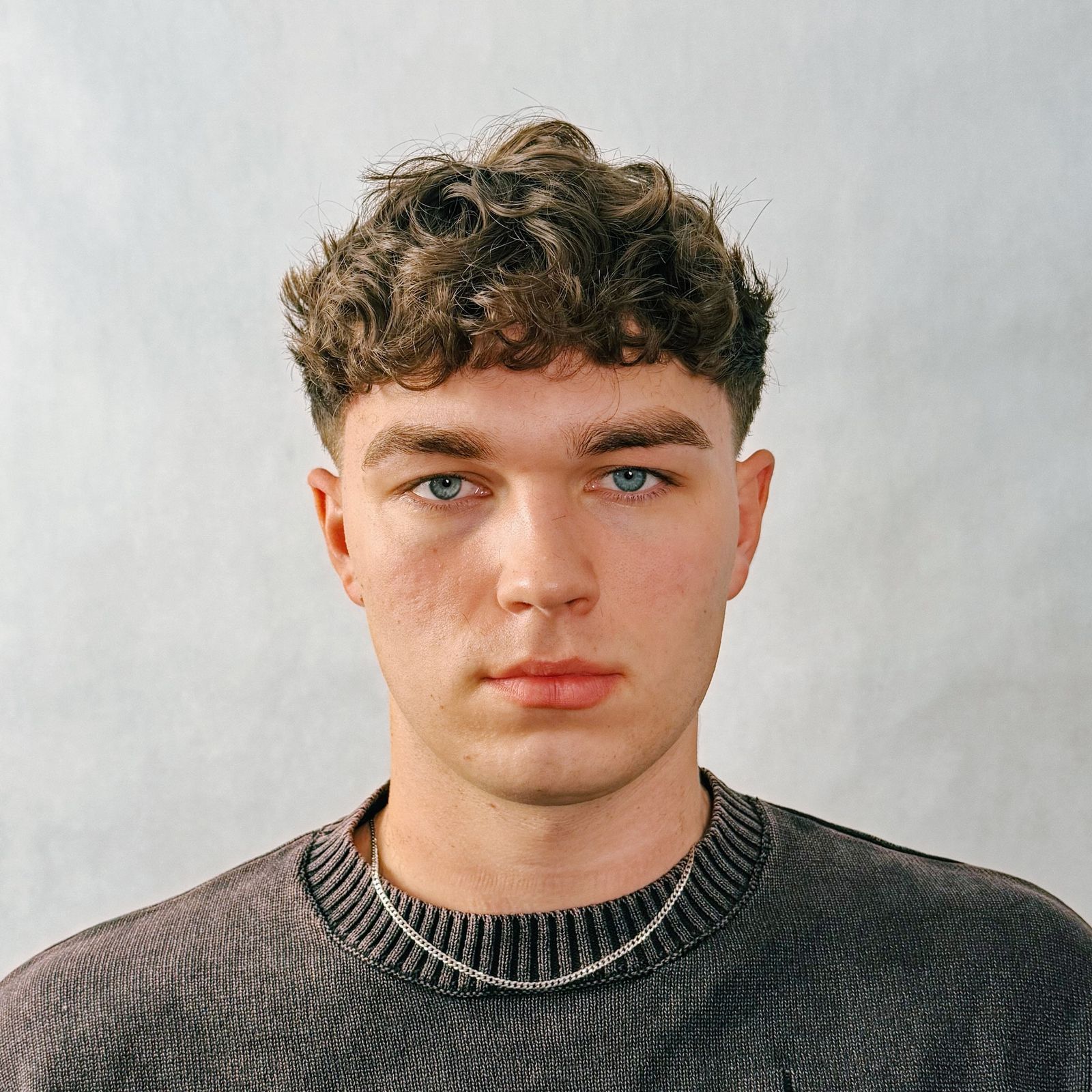
| Messy fringe | Textured fringe falling irregularly onto the forehead | Breaks up forehead width, gives a younger look | All types |
| Side sweep | Longer top with a side part and a soft sweep-over | Asymmetry softens angularity | Medium to fine |
| Textured crop | A short, tight shape with texture on top and a fringe | Volume on top against sharp sides, low maintenance | All types |
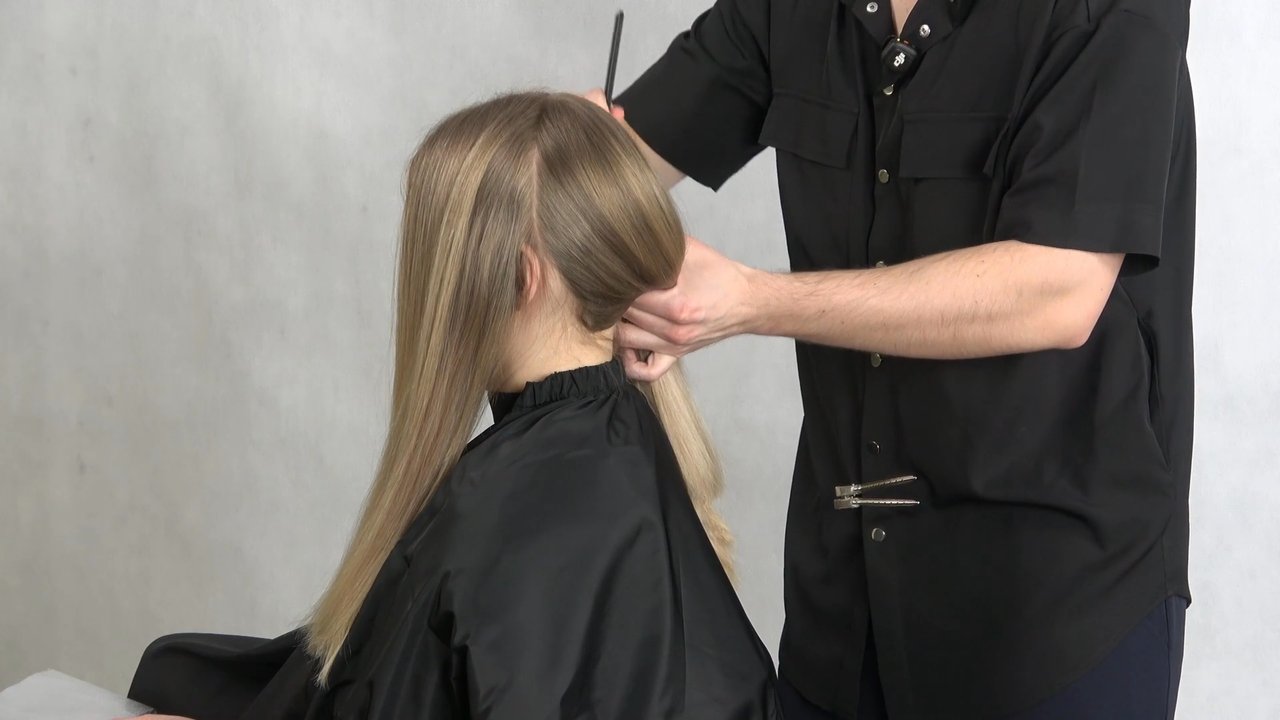
| Long, wavy hair | Shoulder-length hair with a natural wave | The wave breaks up the outline, giving an artistic character | Medium to thick |
| Undercut with a long top | Very short or clipper-cut sides and back, long top | Strong vertical-horizontal contrast, elongates the face | Thick, straight |
Textured quiff
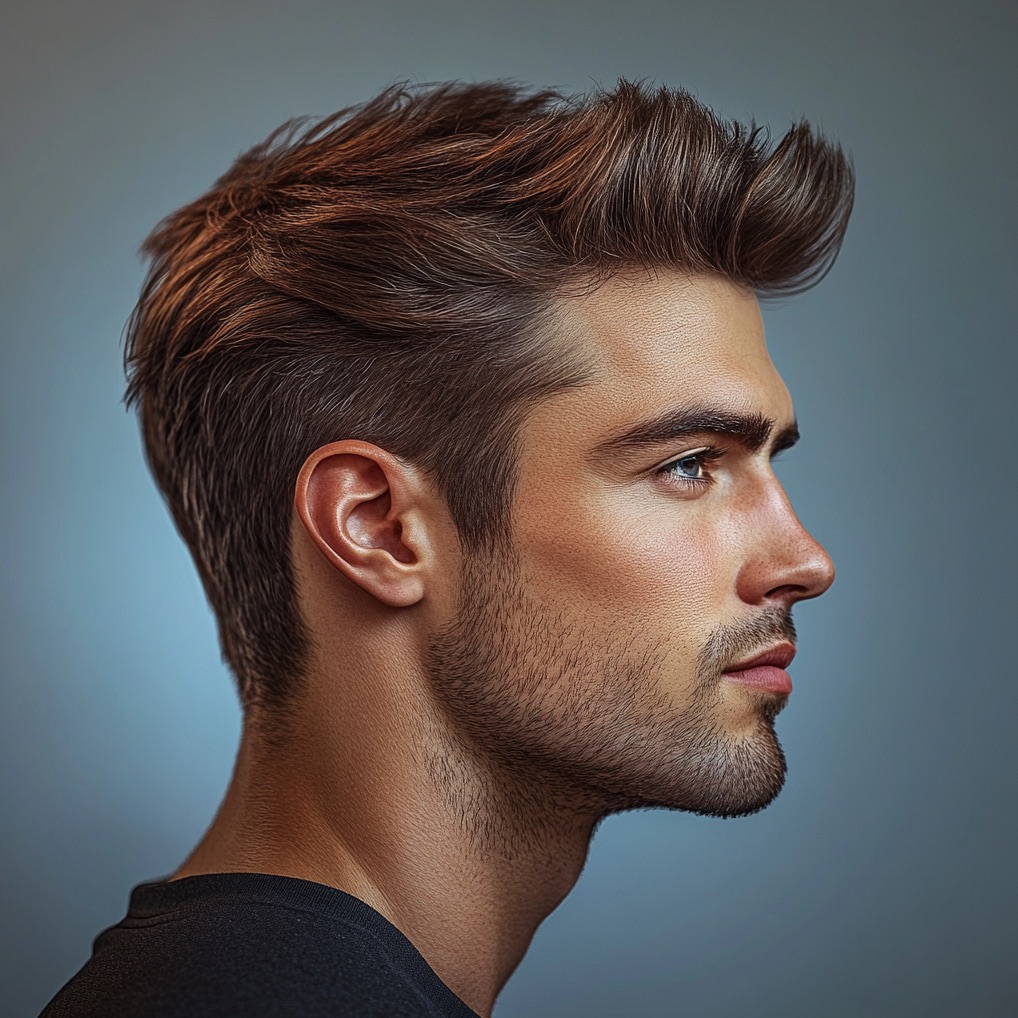
The quiff is a safe choice for a square face, because all the work happens vertically. The top stays longer (usually 8-12 cm), while the sides taper down into a fade or a short taper. The front is the longest section and it's what builds the height; length decreases toward the back so the wave doesn't lie flat.
Cutting: work the top with scissors on elevation. Pull front sections out perpendicular to the head, even slightly forward, to leave more length there. Blend the transition from top to sides softly – over the fingers or scissor-over-comb – without a sharp, visible line. Take the sides down first with clippers (e.g., a guard 1-2 lower, longer toward the top of the temple), then blend with the clippers on open lever or a comb. Thin the ends on top with point cutting so the wave has movement.
Benefits:
- Height on top visually elongates the face and breaks up the 1:1 proportion
- Texture on top breaks up sharp, angular features
- Short sides don't widen the face at jaw level
How to style:
- On damp (not wet) hair, apply a volumizing mousse or spray, working it into the roots
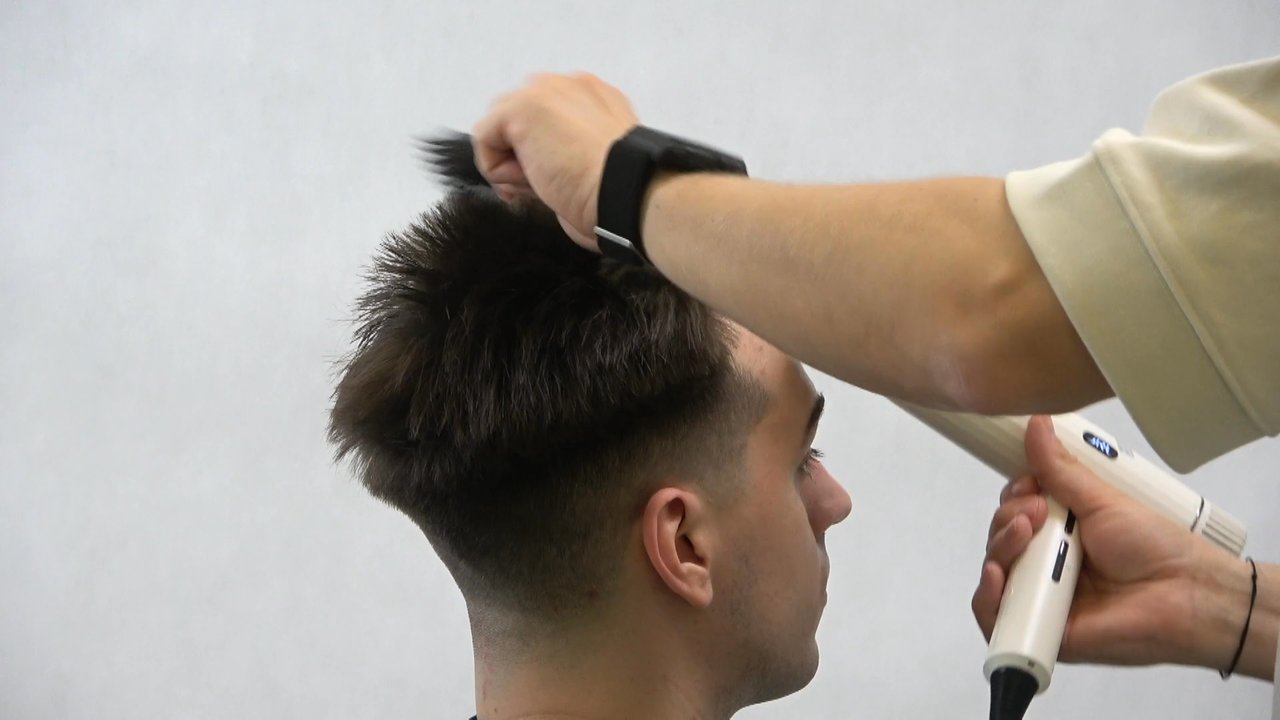
- Blow-dry with a round brush, lifting the roots and directing the front up and back
- Once dry, work in a texturizing paste with a matte finish, shaping the quiff with your fingers
- Set with a light-hold hairspray, holding the can about 20 cm away so you don't clump the texture
Pompadour
The pompadour works exceptionally well on a square face, because all the hair's weight moves up and back, maximizing the elongating effect. The top is longer than in a quiff and more compact, the sides are shorter but rarely clipped down to zero – usually a bit of length is left for a classic, clean transition.
Cutting: leave maximum length on top, especially in the front area, since that's where you build the wave. Shorten the sides and back so they contrast with the top, but keep the transition clean and soft. In a pompadour, the hair needs to lie in a directional pattern, so minimize aggressive surface texturizing – work inside the section instead to remove weight while keeping a smooth line on the surface.
Benefits:
- Elongates the face the most out of all the shapes on this list
- Adds elegance and classic style, pairs well with a suit
- Highlights masculine features without widening the face
How to style:
- On damp hair, apply a root-volumizing product (a pre-styler or a strong-hold mousse)
- Blow-dry with a brush, combing back and lifting the roots at the front to build the base of the wave
- Warm a medium- or strong-hold pomade between your hands and mold the wave, combing from the forehead back
- Finish with a comb for a smooth line, and set with hairspray
For more on how to create the perfect pompadour, check out our article Pompadour: Timeless Elegance in a Modern Take.
Messy fringe
The messy fringe – a textured fringe – suits clients who want to soften sharp features and prefer a casual look over a polished one. The top and front stay longer, with the fringe falling irregularly across the forehead, breaking up its width. It's also a good option for a high or receding hairline, since the fringe covers the hairline.
Cutting: shape the fringe dry, over the fingers, in its natural fall, since hair stretches when wet and it's easy to end up too short. Thin the ends with point cutting, holding the scissors vertically, so the fringe edge looks choppy rather than blunt. A blunt, straight fringe line creates an extra horizontal line and widens the face, which is exactly what we avoid on a square face. Keep the sides short but not necessarily clipped down to zero, so the whole look stays soft.
Benefits:
- Breaks up forehead width and softens the upper part of the face
- Gives a younger, more casual character
- Versatile and easy for everyday styling
How to style:
- On damp hair, apply a mousse or texturizing cream, distributed evenly
- Blow-dry with your fingers, directing the front forward and down to create a natural fringe fall
- Work in a matte paste or wax, separating the fringe strands for a piecey effect
- Don't overload it with product – the whole point of this shape is a slightly undone, natural fall
Hairstyles to Avoid
A square face forgives a lot, but a few choices work directly against the proportions we're usually trying to correct. If the goal is to soften angularity and visually elongate the face, avoid the shapes below, or modify them consciously:
- Buzz cut at a single length
- Why avoid it: a uniform, short length traces the skull and exposes every angle of the jaw and the width of the face
- Alternative: a textured crop with a slightly longer top gives you similarly low maintenance while building height
- A straight, heavy, blunt-cut fringe
- Why avoid it: it creates a strong horizontal line across the forehead, adding extra width and widening the face
- Alternative: a textured, choppy fringe breaks up that line and softens the upper part of the face
- Very long, straight hair tucked behind the ears
- Why avoid it: smoothly tucked-back hair exposes the entire jawline and draws the eye along its angular line
- Alternative: if the client likes long hair, go for a wave or curl that breaks up the outline
- Short sides with a flat top lacking any height
- Why avoid it: lack of height leaves the 1:1 proportion untouched, making the face look even more angular
- Alternative: a shape with clear volume on top, like a quiff or pompadour
- A symmetrical hairstyle with a center part
- Why avoid it: a center part splits the face into two equal halves, reinforcing its natural symmetry and width
- Alternative: an asymmetrical style or a side part that introduces movement across the face
These are guidelines, not bans. With a softer square variant, or when the client has a longer face, some of these shapes can absolutely work. Always base your decision on an analysis of the client's actual features and hair type, not just the label of the face shape.
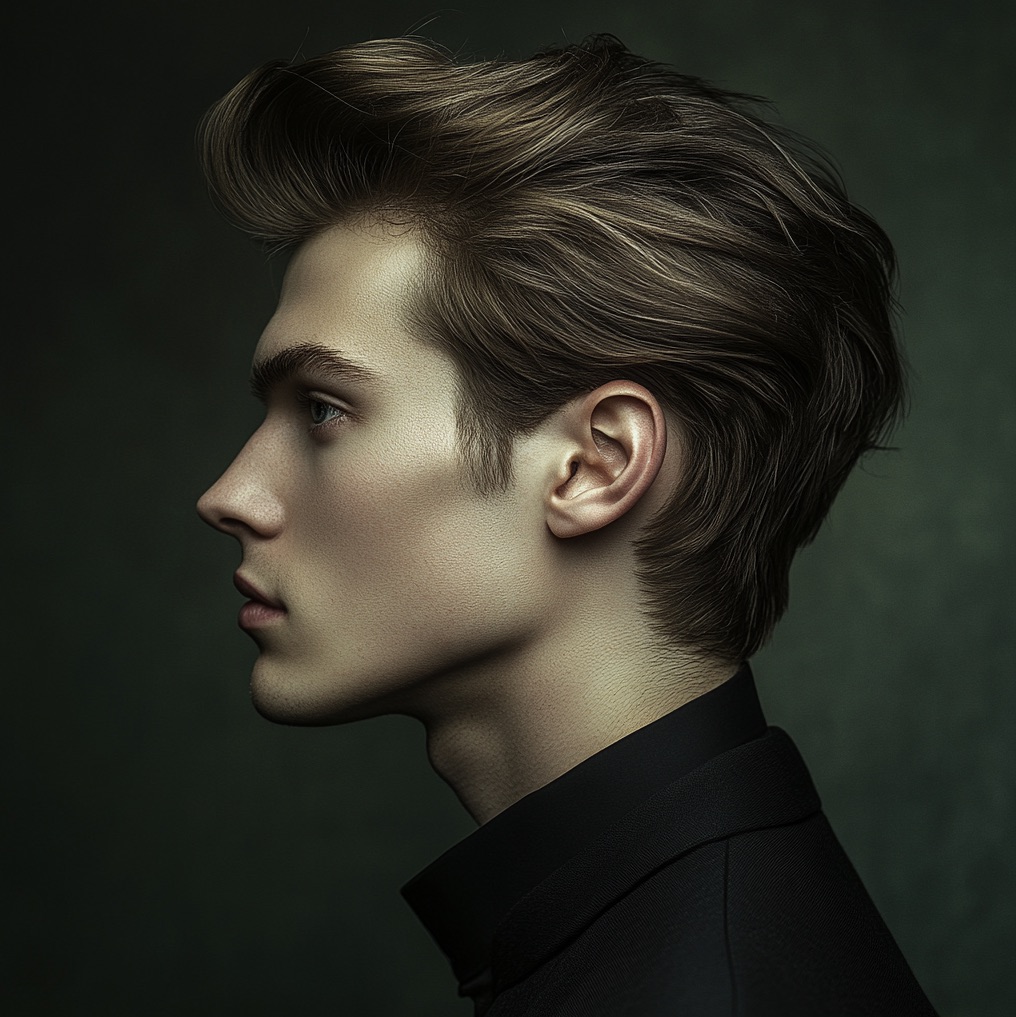
Cutting Techniques for a Square Face
The shape is one thing, but on a square face you win the result through technique: how you handle elevation, where you thin the hair, and how softly you blend the sides into the top. Here's a set of techniques that genuinely work for this face shape.
- Length graduation (elevation)
- What it is: gradually building length from short sides toward a longer top, controlled by the elevation angle of each section
- How to apply it: work the sides at low elevation, and raise sections progressively higher toward the top (up to 90 degrees and beyond) to leave weight and height there
- Effect: a smooth side-to-top transition without a sharp line, with weight concentrated where it elongates the face
- Texturizing (removing weight)
- What it is: giving the interior of the section an irregular structure to remove excess density and introduce movement
- How to apply it: work inside the section with thinning shears or slicing, not on the edge itself; on thick, straight hair, remove weight deeper into the section
- Effect: a lighter, more mobile top that breaks up angularity and holds textured styling better
- Point cutting
- What it is: cutting the ends with the tips of the scissors held at an angle, vertically, for a soft, irregular edge
- How to apply it: hold the scissors perpendicular to the section and cut into the ends with shallow movements; the deeper you go, the choppier the edge
- Effect: a soft line against the sharp angles of the face, ideal for finishing the fringe and front
- Working the sides: taper and fade
- What it is: gradually shortening the hair on the sides from bottom to top, using clippers with guards or the scissor-over-comb technique
- How to apply it: start with the shortest guard at the bottom, a longer one higher up, and blend the transition zone softly with the clippers on open lever so you don't leave a line; when using a comb, keep the teeth parallel to the skull
- Effect: tight sides that don't widen the face and set up contrast with a high top
- Freehand cutting
- What it is: cutting without a comb, freehand, following the hair's natural fall
- How to apply it: pick up small sections between your fingers or cut in the natural fall, judging length by eye – especially when finishing the texture on top and the fringe
- Effect: naturally looking texture and volume, without a rigid, geometric shape
- Razor cutting
- What it is: layering and texturizing the ends with a razor instead of scissors
- How to apply it: work only on damp hair, with a sharp blade, at a flat angle, on thick and straight hair – a razor on fine or weakened hair will fray it
- Effect: lightness and movement at the ends, a soft finish that contrasts with an angular face
- Disconnection
- What it is: a deliberate, clear contrast between sections with no blended transition (e.g., a long top and clipper-cut sides)
- How to apply it: leave the top long and separate it from the short sides with a clear line; on a square face this works well with an undercut featuring strong height
- Effect: a strong vertical accent and character, additionally pulling the face upward
Applying these techniques takes practice and experience. If you want to deepen your knowledge of advanced cutting techniques, I encourage you to check out our course Shaping Volume and Form in Men's Cutting.
On a square face, combining these techniques works best: a clean fade or taper on the sides for tightness, high elevation on top for height, and point cutting plus texturizing for softening. Match the depth of texturizing to the hair's density – on fine hair, remove weight cautiously so you don't strip the top of the volume you need most here.
Styling and Products
Even the best-cut shape will fall apart without proper styling. On a square face, the goal stays constant: build height on top and introduce texture that softens the features. Match your finish (matte versus glossy) and hold to the shape.
| Product | Use | Effect | Best hairstyle |
|---|---|---|---|
| Matte paste | Texturizing and hold without shine | Natural, matte look, adds volume | Textured crop, messy fringe |
| Pomade | Classic, directional, swept-back shapes | Shine and strong hold, a smooth line | Pompadour, side sweep |
| Mousse | Root-volume base before blow-drying | Light hold, lifts the roots | Quiff, long wavy hair |
| Sea salt spray | Texture and a beachy wave effect | Natural roughness, a bit of undone texture | Messy fringe, medium lengths |
| Wax | Defining and separating strands | Medium, flexible hold | Textured quiff, short shapes |
| Styling cream | Frizz control, light smoothing | Hydrates and disciplines the hair | Long hair, side sweep |
Styling techniques
- Blow-drying and building the roots
- Dry damp, not dripping, hair – first rough-dry the whole head, then refine the front area
- Lift the roots with a round brush, directing the airflow under the hair to build height
- For a matte texture, dry with your fingers instead of a brush, tousling the hair in different directions
- Applying product
- Start with a small amount – you can always add more product, but removing the excess is harder
- Warm and rub the product between your hands into a thin, even layer before applying
- Apply from the back of the head toward the front, leaving the front for last, so you don't weigh down or clump the hair near the face
- Creating texture
- Rough up the top with your fingers, breaking up dense strands so the hairstyle gains movement and volume
- For a more defined effect, reach for a wide-toothed comb, not a fine one
- Direct the front up and slightly back, emphasizing the height that balances the jaw
For more detailed styling advice, check out our article How to Style Men's Hair: Tips for Clients.
Hair Care for a Square Face
With shapes that live on height and texture, hair condition is part of the result. Damaged, over-dried hair won't hold root volume and responds worse to styling. Share this simple at-home routine with your client:
- Washing
- Shampoo and conditioner matched to hair type and scalp
- Don't wash daily – 2-3 times a week is usually enough to avoid stripping natural sebum
- Rinse with cool water at the end to close the cuticle and add shine
- Hydration
- A hydrating mask once a week, especially for longer shapes
- Serum or oil on the ends, a small amount, so you don't weigh down or flatten the roots
- Proper hydration of the body supports hair condition
- Protection from damage
- Limit hot tools and work at a medium dryer temperature
- Always use a heat-protectant product before blow-drying or straightening
- Don't rub the hair with a towel – gently blot it dry with a microfiber towel to avoid frizzing it up
- Regularly refreshing the shape
- Refresh short shapes with a fade every 3-4 weeks, since the sides lose their clean contrast the fastest
- Trim the ends of longer hair every 6-8 weeks to avoid split ends and keep the line intact
- A hair-supporting diet
- Protein along with vitamins A, C, E, and biotin support hair condition from the inside
- Supplementation only makes sense when diet alone doesn't cover deficiencies – that's a topic for a consultation, not guesswork
For detailed care advice, check out our complete grooming guide.
Choosing Facial Hair for a Square Face
Facial hair is the second tool, after the haircut, for shaping proportion. On a square face, you control the length and line of the beard: lengthen it at the chin and jaw front to pull the face vertically, and shorten it on the sides so you don't widen the jawline. A short, even beard softens angles; a beard that's longer at the front visually elongates the face, while widening the sides of the beard works against that goal.
| Type of facial hair | Effect | Recommendations |
|---|---|---|
| Full beard | Can emphasize the square outline if built up on the sides | Keep the sides short, leave more length at the front and chin to elongate, not widen |
| Short stubble | Softens features, adds character | A safe choice when you want to soften sharp angles without adding bulk |
| Goatee | Concentrates facial hair mass at the chin and elongates the face | Good when you want a vertical accent and a slimmer lower face |
| Clean-shaven face | Reveals the natural, strong shape of the face | Requires a clean line and good skin care – exposes the jaw without any correction |
| Mustache | Adds character, shifts attention from the angular jaw toward the center of the face | Match the mustache style to facial hair density and features |
| Sideburns | Widen the face at cheek and jaw level | Avoid long, built-up sideburns if the goal is softening the square shape |
Facial hair grooming tips
- Trim facial hair regularly with a trimmer, keeping the sides shorter and the front longer to maintain a flattering proportion
- Set and maintain a clean cheek line and neckline – these are what determine a tidy look
- Use beard oil to soften the hair and soothe the skin underneath
- Wash facial hair with a dedicated beard shampoo – regular hair shampoo over-dries the skin
- Comb and shape the beard with a brush, directing the hair down and toward the center so you don't build up the sides
Find out more about beard care in our article How to Care for a Beard: A Complete Grooming Guide.
Celebrity Inspiration
A square face is a classic feature among male film and sports stars. These examples show clearly how different shapes work on the same face shape, and they're useful as a reference point when talking to a client behind the chair:
- Brad Pitt
- Often wears textured, medium-length hairstyles that add movement on top
- Experiments with facial hair, from light stubble to a full beard, adjusting facial proportions
- David Beckham
- Known for frequent changes, from short crops to longer, swept-back styles
- Often sports carefully trimmed facial hair that cleans up the jawline
- Henry Cavill
- Classic shapes with a side sweep and height on top
- A full beard balances his strong, square jaw well
- Nick Bateman
- Longer, textured shapes that add softness to his features
- Well-groomed facial hair completes and tidies up the overall look
- Channing Tatum
- Usually short shapes with texture on top
- Light stubble softens his sharp facial features
Celebrity inspiration is a starting point, not a template to copy exactly. Behind the chair, you still filter the choice through the client's hair type, density, hairline, and lifestyle. What a stylist maintains on set won't always hold up with a five-minute at-home styling routine, so choose a shape that's realistic to maintain.
Find more inspiration in our article on the most popular men's hairstyles inspired by celebrities.