Thinning hair is one of the most common challenges you'll face behind the chair in a men's grooming space. The client sits down and says his scalp is “showing through on top” or that his hairline “is receding at the front.” Your job is to choose a shape that optically thickens the hair rather than exposing the scalp, and to execute it with the technical precision that keeps the result holding up at home too. Below you'll find specific hairstyles for thinning hair on men, along with the cutting, sectioning, and finishing techniques you can put to use right away.
Understanding the Thinning Hair Problem
Causes of Hair Thinning
Before you pick up the clippers, read the client's head. Diagnosis determines whether you go with a short cut, a longer textured shape, or refer the client for a trichology consultation.
- Pattern baldness (receding hairline, crown thinning): the characteristic recession of the frontal line combined with thinning at the crown. Here you're working to mask the contrast between dense and thin zones.
- Diffuse thinning: hair is present all over the head, but fine and lacking support. Here the game is about volume at the root and texture, not about hiding exposed scalp.
- Naturally fine hair: a high density of hair, but with small diameter. It's easy to weigh down and falls flat fast. The key is a light finish and a cut that adds shape.
A practical consultation test: part the hair with a comb in several spots and assess where the scalp shows through most and where there's enough weight. This will show you which zone to leave longer as a “donor” of density, and which to shorten.
Golden rule: with thinning hair, avoid “in-between” lengths that hang and expose the scalp under their own weight. Go either very short and even, or longer with texture that breaks up the light. Anything in between usually exposes the problem.
Tip: Check out our article “10 Key Skills Every Hairdresser Should Learn“, where you'll find information on the latest trends in hair care.
Short Hairstyles for Thinning Hair
Buzz Cut and Its Variations
The Buzz Cut evens out density: since everything is uniformly short, the eye stops comparing dense zones with thin ones and the thinning stops standing out. The shorter the length, the smaller the contrast between hair and scalp, which is why with a strong receding hairline a lower guard than you'd instinctively choose often works best.
- Choosing the guard: for an even buzz you'll usually start with guard #3-4 (9-13 mm) on top. With a visible receding hairline, go shorter on top (guard #2) to reduce contrast.
- Guiding the clippers: always cut against the grain, opposite to the direction of growth, with the guard flat against the scalp. Work in sections from bottom to top, overlapping the previous pass so you don't leave “steps.”
- Graduated variation: guard #3 on top, guards #1-2 on the sides, with a soft transition between them using the clippers with no guard via the clipper-over-comb technique. This gives a cleaner head outline without the “flowerpot” effect.
- Frontal hairline: with a receding hairline, don't draw a sharp, straight front. Soften it by working point by point with a trimmer, so the receding areas aren't emphasized by a hard edge.
Finally, check the head under light from several angles — thinning hair reveals unevenness that doesn't show up in shadow. Catch any “islands” of longer hair with clipper-over-comb.
Tip: Check out our “Buzzcut” course to learn the perfect technique for this haircut.
Crop with a Fade
The crop is today's most flattering shape for a thinning hairline. Short, choppy, textured fringe masks a receding hairline, while a fade on the sides shifts attention to a clean, dense head outline. The higher you start the transition, the more weight stays on top, and the more you optically thicken the crown.
- Set the zones. Mark the cutting line (perimeter) around the head. Above it, weight stays for the crop; below it, the fade begins.
- Build the fade. Work with guards from the lowest upward, grading as you go: #0/0.5 at the bottom, then successive passes higher up. Blend the passes with a flicking motion, rolling the wrist away from the scalp so you don't leave a line.
- Shorten the top with a comb. Clipper-over-comb or scissor-over-comb technique: angle the comb against the scalp, removing excess in layers, controlling length with the comb angle, not the clippers.
- Add texture to the fringe. Point cutting (cutting into the section with the tips of the shears) on the front edge breaks the hard fringe line into individual strands. This is the key move for thinning hair — a hard, smooth edge exposes, while a choppy one thickens.
- Thin the weight. Using thinning shears, remove excess weight from the middle of the section (not from the ends) point by point, so the hair stands up instead of falling flat against the scalp.
A note for fine hair: use thinning shears sparingly and higher up in the section. Over-thinning fine hair creates a “see-through” effect instead of volume.
Tip: To learn how to create the perfect transitions, sign up for our “Burst Fade“ course.
Medium-Length Hairstyles for Thinning Hair
Textured Quiff
The quiff works on thinning hair under one condition: volume is built by the cut and the root styling, not by product alone. You leave more length at the front, which you lift up and back, making the crown area look fuller. Keep the sides shorter (fade or taper) so the contrast emphasizes the height on top.
- Length distribution: the most weight at the front and on the crown, tapering gradually toward the back. It's that front weight that “makes” the quiff.
- Layering: cut layers by lifting sections at an angle (elevation), so the top hair supports the hair underneath. A flat, uniform cut on fine hair will fall flat and lifeless.
- Thinning the ends: point cutting on the ends breaks up weight and adds movement, but don't cut too deep into fine hair or you'll lose the weight you need.
During the consultation, honestly assess how much upkeep this shape requires at home. A quiff on thinning hair lives and dies by the blow-dryer and product — if the client won't style it, suggest a crop instead.
Tip: Use hair powder to add texture and volume. Learn this technique in our course “Shaping Volume and Form in Men's Haircutting“.
Modern Pompadour
The pompadour is built on height at the root, and height is exactly what thinning hair needs. However, the classic, heavily styled and glossy version will expose thinning, so for fine hair go with a modern, more matte and softer version, where the front is full but not slicked back stiffly.
- Front length: leave enough hair at the front so it can be lifted and swept back, building an arch at the root.
- Disconnect or taper on the sides: short sides frame the full top. A higher transition means more visible weight on the crown.
- Matte finish: shine highlights where hair is missing. A product with a matte or satin finish will hold the shape without “giving away” the scalp.
Tip: Check out our article “Pompadour: Timeless Elegance in a Modern Take” for inspiration and tips.
Styling Tricks
The Right Products
With thin, fine hair, product can ruin a good cut in a matter of seconds. Heavy pomade clumps strands together and the scalp shows through underneath. Stick to light, matte formulas that add texture and separate the hair instead of weighing it down.
- Hair powder: applied at the root, it gives an instant lift and matte grip, perfect when volume is lacking.
- Matte paste or cream: texture and control without shine or clumping.
- Texturizing rubs and sea salt products: break the hair into individual strands, which optically thickens it.
- What to avoid: wet, high-shine gels and heavy pomades — on fine hair, they weigh it down and expose the scalp.
Use minimal amounts. It's better to add a second, thin layer than to weigh the hair down with too much product at once. Apply to dry or lightly damp hair, never wet.
Tip: Recommend light texturizing products to clients that won't weigh the hair down. You can draw inspiration from our course “Pompadour Styling“.
Blow-Drying Techniques
Blow-drying is the stage where most of the volume is created. Most clients with thinning hair dry it “downward,” flat against the head, and then wonder why the hairstyle doesn't hold. Teach them to work at the root.
- Pre-dry with a towel, blotting rather than rubbing, to avoid frizzing fine hair with static.
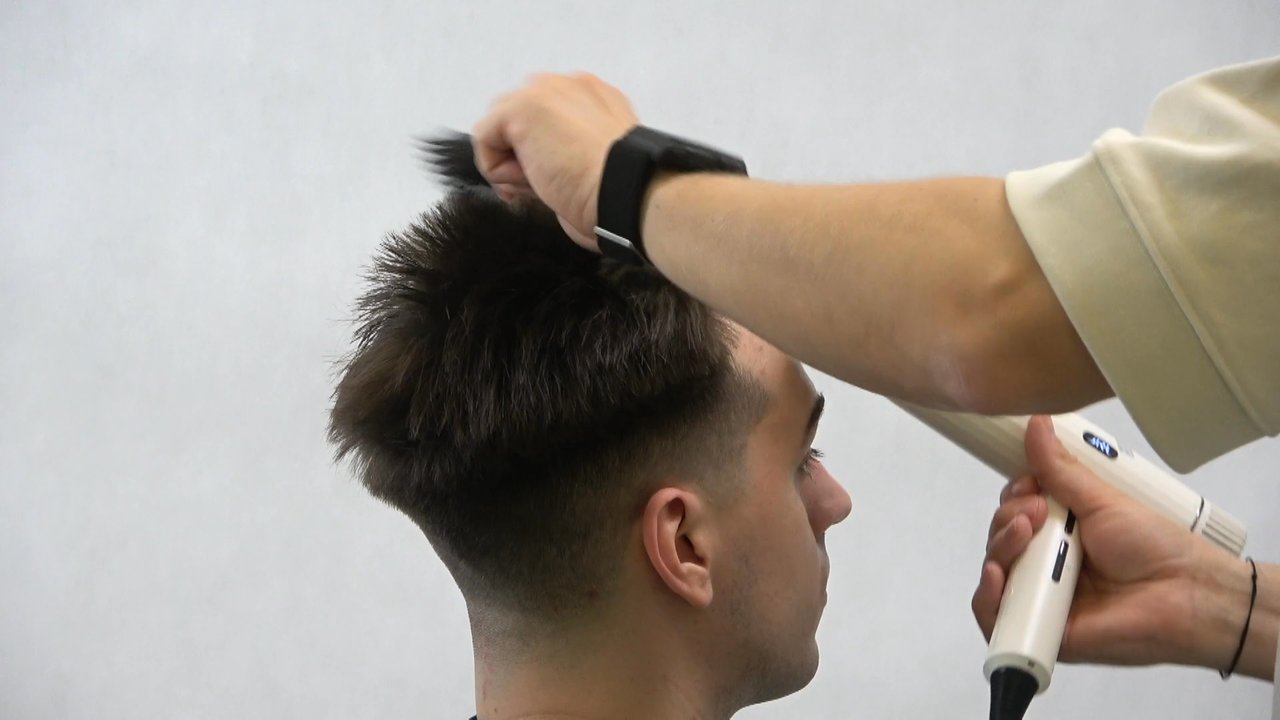
- Dry against the grain, from the root. Direct the airflow opposite to the natural fall to lift the hair at the root — this is where volume is born.
- Work with a round brush. Pick up sections at the root, pull them upward, and apply warm air, then cool with a cold shot to lock in the lift.
- Direct the shape. Only once you have root volume should you style the form (backward for a quiff/pompadour, forward for a crop).
The cool shot button is, for fine hair, the most important button on the dryer — it “locks in” the volume you built with heat.
Tip: Teach clients how to blow-dry their hair by lifting it at the root with a round brush. It's a simple technique that can work wonders on thinning hair.
Innovative Solutions
Scalp Micropigmentation
Scalp micropigmentation (SMP) is a technique that deposits pigment into the epidermis, mimicking the look of a shaved-stubble shadow on the scalp. On thinning areas, it optically reduces the contrast between hair and visible scalp, making a short cut look denser. It pairs best with the very short shapes you'd suggest for advanced thinning.
This is a separate specialization requiring dedicated training and adherence to sanitation standards. If you don't perform it yourself, it's worth having a trusted partner to refer clients to, and knowing how to advise on a cut that will blend well with the pigmentation effect.
Tip: Consider expanding your service menu with this offering. You can learn more about innovative hairdressing techniques in our article “5 Hottest Hairdressing Trends“.
Hair Replacement Systems
Hair replacement systems (so-called hair systems) are additions made of natural or synthetic hair applied to thinning areas and attached to the scalp. For clients with advanced hair loss who don't want to go very short, they can be the only route to a dense-looking result. This service requires precise matching of color, texture, and hairline, along with regular maintenance and cutting of the system itself so it blends seamlessly with the client's own hair.
Tip: Educate yourself on the latest hair replacement technologies. This could be a valuable extension of your service offering.
A Holistic Approach
A Healthy Lifestyle
Hair condition starts with the scalp and what's happening inside the body. As a hairdresser, you're not a replacement for a doctor or dietitian, but you're the person who regularly sees the client's scalp up close. You're often the first to notice a sudden change, irritation, or progressive thinning, and you can suggest a specialist consultation in time.
In conversation with the client, it's worth highlighting the basics they can actually influence: gentle scalp washing, avoiding heavy, weighing-down products day to day, and not over-drying hair with excessive heat. These are simple messages that build your position as an advisor, not just a technician.
Tip: Encourage clients toward a healthy lifestyle that can improve their hair's condition. You can recommend our podcast “On Things Forgotten and Pushed Aside“, where we discuss a holistic approach to hair health.
Summary
With thinning hair, there's no single “magic” hairstyle — what wins is an accurate diagnosis and matching the shape to the type of thinning. Short cuts (buzz, crop with a fade) even out contrast and mask exposed scalp. Medium-length shapes (quiff, pompadour) build volume but require styling upkeep at home. Micropigmentation and hair systems are options for advanced hair loss. In every case, the result comes down to technique: the angle of the clippers, sectioning, thinning, and finishing with point cutting, followed by root-lifting blow-drying.
To stay up to date with the latest trends and techniques in men's hairdressing, we encourage you to regularly visit our blog and explore our course offering. Continuously raising your game is the fastest way to turn tougher cases, like thinning hair, into your strong suit.