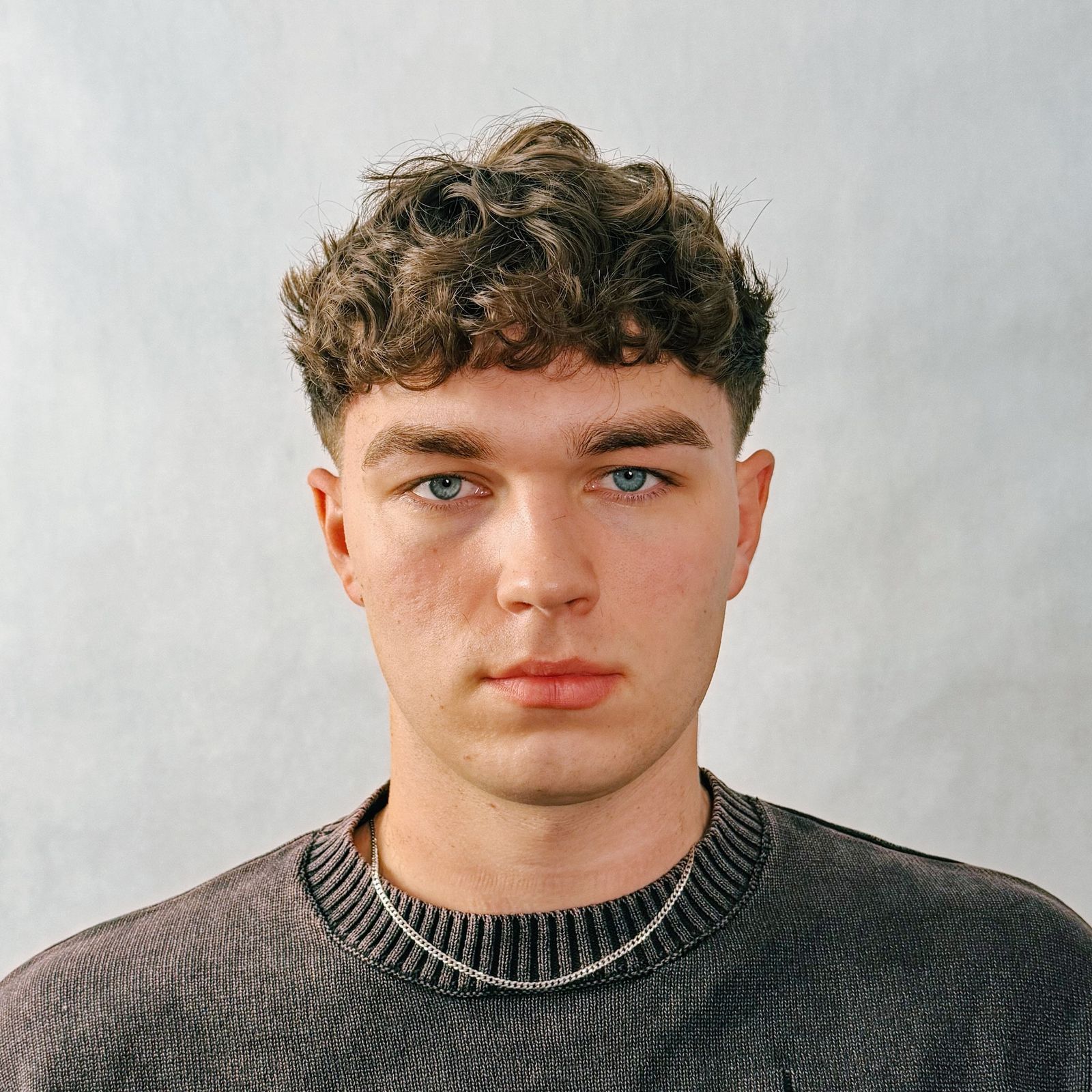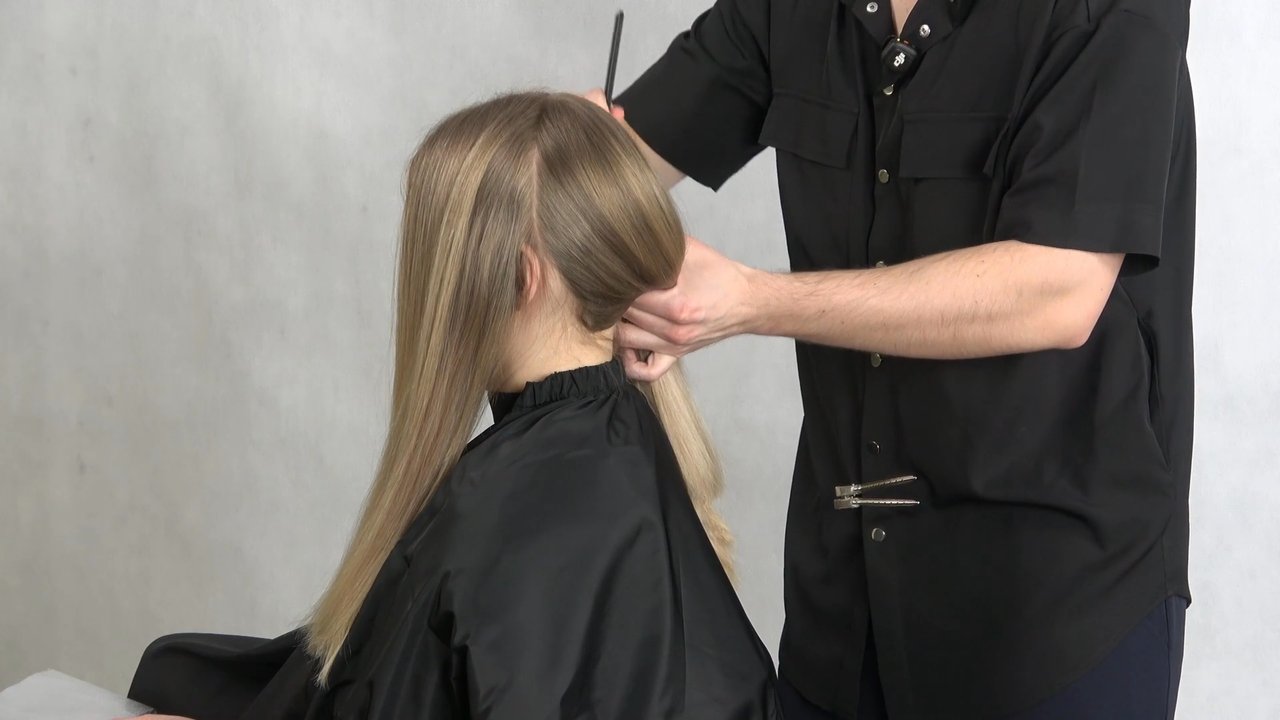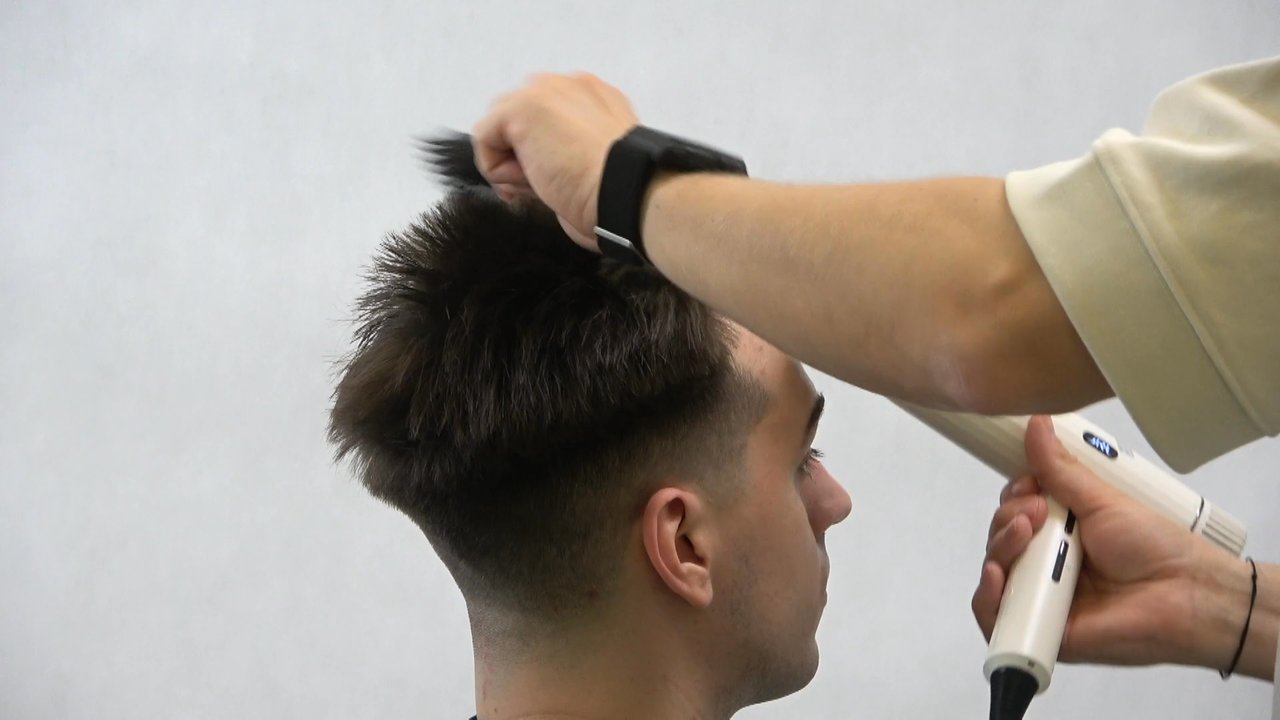
For the client, an office hairstyle is a work tool: it has to hold its shape from the morning commute to the afternoon meeting, style in 3 minutes in front of the mirror, and forgive a lack of styling skill. For us, hairdressers and barbers, that means one thing: the cut has to be clean and self-supporting enough to work even when the client doesn't touch it. Below, I break down the most popular men's office styles piece by piece: how to section, what angles to work, what to finish with, and what to advise behind the chair so the client comes back to you instead of experimenting on his own.
What makes a hairstyle “office-appropriate”
An office style isn't a separate technique — it's a set of constraints we apply to a classic cut. In practice, it comes down to four things:
- Clean line-up – the line at the ear and nape should be defined but soft. A hard zero-line edge looks great for a week, then the client ends up with a visible “ring” of regrowth. For office looks, it's better to leave a natural or lightly defined line-up that grows out gracefully.
- Volume control on the sides – the sides can't “stick out.” The thicker and wavier the hair, the shorter the sides or the stronger the graduation needs to be.
- A top that styles in a few moves – the length and texture on top must be workable with a comb or fingers, no straightener and no fifteen minutes of effort required.
- Regrowth that doesn't ruin the shape – you choose lengths so the style still holds its form after 2-3 weeks. That's the difference between a cut the client brags about to his mates and one that sends him back in a bad mood.
If you want to sharpen your full men's cutting craft, from line-up to graduation, this piece pairs well with our online hairdressing courses.
Classic office hairstyles and how to cut them
1. Side Part
The safest office style and the starting point for most corporate hairstyles. It suits straight and slightly wavy hair, and works best on oval and square face shapes.
Behind the chair:
- Find the natural parting – comb the wet hair forward from the crown; the parting line will reveal itself. Work with it, not against it, and the shape will hold on its own.
- Work the sides and back with a #1.5-3 guard (4-9 mm), graduating down to the skin near the ear if the client wants it cleaner. Guide the clippers at an angle from bottom to top, blending the transition with clipper-over-comb in the area above the ear.
- Cut the top with scissor-over-comb, working from the parting toward the side, so the hair on the side opposite the parting is slightly longer – that's what creates the “sweep-over.”
- Finish with light mid-strand thinning using texturizing shears, only at the root, to remove weight. Don't thin the ends, or you'll lose the smooth line of the sweep-over.
- Styling: apply a medium-hold pomade to slightly dried hair, comb along the parting, then finish with hairspray from a distance for hold without stiffness.
The Side Part pairs well with a behind-the-chair care service, such as a professional face and shoulder massage, which adds value to the visit without extending the cutting time itself.
2. Classic Pompadour
The pompadour delivers height and character, and in its office version you keep it neat: short sides, a smooth top, a defined wave at the front. The key is a length disparity – you really need a minimum of 7-10 cm on top to have something to lift.
- Section classically: separate the top with a line running above the temples and meeting at the back (a “disconnect” zone or a soft transition, depending on the client's preference).
- Graduate the sides from the base of the ear upward – for office looks, a low or mid fade works well, leaving some density and not demanding a weekly touch-up.
- Even out the top with scissors, lifting the sections to a 90-degree elevation from the head, making sure the front is longer than the crown area – the front is what builds the wave.
- Blow-drying does half the work here: apply a volumizing product, lift the roots with a round brush, direct the airflow from the forehead to the back, and finish drying the front upward.
- Shape the wave with pomade or wax, using your fingers from the forehead to the back, then finish with hairspray. For office looks, aim for a matte-satin finish, not a wet shine.
You'll find the full breakdown of this style, from sectioning to finish, in the Pompadour Styling course.
3. Textured Crop (short cut with texture)
The most “low-maintenance” office style, and a lifesaver for clients with fine hair or a receding hairline, since the forward fringe masks the hairline. It suits almost any hair type if you dial in the right amount of texture.
- Graduate the sides short (low/mid fade), and leave the top at 4-6 cm – enough to get texture and a fringe without weight.
- Finish the top with point cutting – cut vertically into the section with the tips of the scissors to break up the hard line and create irregular, natural-looking ends.
- Trim the fringe dry, checking how it actually falls – wet hair is misleading about length, and the crop lives on the texture of the front.
- Styling: rub matte paste or clay between your hands and apply by running your fingers through the hair. No comb, no shine – that's the whole point of this style.
The crop pairs well with a professional facial care service, which boosts the well-groomed, “fresh” impression while keeping chair time short.
Modern office hairstyles for bolder clients
1. Undercut
The undercut is a “disconnect” style: the sides and back are cut to one length with no blend, and the top stays long, clearly separated by a defined line. In the office, it works well in less formal industries – the client gets strong contrast, but a styled-back top reads as elegant.
- Set the disconnect line around the head at the level of the top edge of the temples – this determines the proportion. The lower it sits, the more dramatic the effect.
- Cut the sides and back with a single guard (usually #0.5-2, i.e. 1.5-6 mm) with no blending – by definition, an undercut has no fade, just a clean wall.
- Leave the top long and even it out with scissors; decide the direction of the sweep (back, to the side, or slightly tousled) together with the client, since the undercut forgives day-to-day changes.
- Warn the client about upkeep: the disconnect line loses definition quickly, so a side touch-up every 2-3 weeks is a must.
If the client pairs the undercut with facial hair, send him our beard care guide so the facial contour works together with the cutting line.
2. Slicked Back
The most formal of the modern styles: the entire top is slicked flat back, with no parting. It requires denser, straight or slightly wavy hair – on fine hair the scalp shows through, and on tightly curly hair it won't hold direction.
- Treat the sides with a shadow fade or a short guard – the slick back likes a clean side that emphasizes the direction of the sweep-back.
- Leave the top long enough that once combed back, the hair reaches past the crown – anything shorter will keep lifting up.
- Apply a strong-hold pomade or gel to damp hair and work it through with a wide-tooth comb from the forehead to the back.
- Finish drying with a blow-dryer, directing the airflow from the forehead to the back of the head, and smooth it out with a brush to eliminate any “steps.”
- Set with hairspray. For office looks, avoid the wet-look effect – a satin finish looks more expensive and less “nightclub.”
This style pairs perfectly with a beard – if the client has one, our guide on cutting and trimming a long beard will come in handy.
3. Quiff
The quiff is the pompadour's “gentler sibling”: you still build height at the front, but with a softer, more textured front instead of a smooth wave. It's a good choice for fine hair, since the lifted root creates the illusion of density.
- Graduate the sides moderately (low/mid fade), and leave the top longer at the front than at the back – the front is the “engine” of the quiff.
- Lightly thin the ends on top to leave some texture – the quiff lives on an irregular front, not a smooth plane.
- Blow-dry styling: apply mousse at the root, lift with a round brush, and comb the front upward and slightly back.
- Shape it with a medium-hold paste or wax, separate the sections with your fingers for texture, and set with hairspray.
The quiff is also a great canvas for personalizing the cut – if the client asks about more personal interpretations, check out our article on culturally inspired hairstyles.
Matching the office style to hair type
The dress code sets the boundary of formality, but it's the hair type that decides whether a given style holds up at all. The table below is a shorthand you can use to guide the conversation behind the chair:
| Hair type | Recommended hairstyle | Why it works |
|---|---|---|
| Straight | Side Part | Holds the parting and sweep-over smoothly, easy to cut a clean line |
| Wavy | Textured crop | The style feeds off the natural wave, point cutting enhances the movement |
| Curly | Short sides, longer on top | Graduated sides control volume, the top retains the curl |
| Fine | Short Quiff | The lifted root creates the illusion of density |
| Thick | Slicked Back | Density helps the sweep-back hold its direction and plane |
| With a high/receding hairline | Textured crop | The forward fringe masks the hairline |
Regardless of hair type, the foundation is a clean cut and proper sectioning. If you want to deepen your craft, check out our article on men's cutting techniques.
What to advise clients about at-home maintenance
A style only holds up for as long as the client maintains it between visits. These are the rules worth sharing behind the chair, ideally tailored to the specific cut:
- Washing every 2-3 days – daily washing strips the natural film and makes styling products hold less well; washing less often leads to greasiness. Two to three days is the sweet spot for most.
- A product matched to the style – pomade and gel for sweep-over styles (side part, slick back), matte paste and clay for the crop and quiff. The wrong texture can kill even a great cut.
- A touch-up every 3-4 weeks – that's how long most office styles hold up; fades and undercuts need more frequent visits, since the blend and line-up lose definition the fastest.
- Hydration – conditioner after every wash and a mask once a week keep the hair in good condition, which makes styling easier and reduces frizz.
- Style on slightly dried hair, not soaking wet – most pastes and pomades grip better on lightly damp hair than on dripping wet hair; this is a common mistake clients make at home.
If the client also has facial hair, it's worth linking him to our complete care guide, so maintaining the hairstyle and the beard go hand in hand.
Common mistakes with office styles
These slip-ups show up both behind the chair and in at-home styling. It's worth knowing them so you can prevent the problem instead of fixing a complaint afterward:
- A line-up that's too hard – a sharp zero-line edge at the ear and nape looks great right after the cut, but after a week the regrowth creates a visible “ring.” For office looks, a soft, gracefully growing-out line-up holds up longer.
- Not enough length on top for styles with height – a pompadour or slick back without a real length buffer won't hold direction and will keep lifting up. Better to talk the client out of the style than leave him with something that doesn't work.
- Thinning the ends where a smooth line is needed – texturizing shears on the ends of a sweep-over break up the plane. Remove weight at the root, not at the ends.
- A style beyond the client's skill level – if the client can't style it himself in the morning, the haircut is the wrong choice. Match the complexity to his patience and skill.
- Ignoring the direction of hair growth – working against the natural parting and whorls makes the style “escape” throughout the day. Follow the growth pattern, don't fight it.
Matching the style to face shape
Face shape determines where to add volume and where to remove it. There's one rule: you're aiming for a visual oval – add volume where the face is “too narrow,” flatten it where it's “too wide.”
| Face shape | Recommended hairstyle | Why it works |
|---|---|---|
| Oval | Almost any hairstyle | A proportional shape suits most styles |
| Round | Quiff, Pompadour | Height on top elongates and slims the face |
| Square | Side Part, Textured crop | Soft sides soften strong jawline angles |
| Long/Oblong | Short sides, texture on top | A low top optically shortens the face, the sides add width |
| Diamond | Fringe, Textured crop | Volume on top balances out wide cheekbones |
| Triangular | Longer sides, short top | Width on the sides balances a strong jawline |
| Heart | Slicked Back, Side Part | Volume at the sides balances a wider forehead |
The table is a starting point, not gospel. You make the real decision with a live client, looking at the hairline, density, and whorls – which is why the consultation behind the chair is part of the service, not an add-on.
Trends in men's office hairstyles
Men's hairdressing is moving toward greater acceptance of individual styles, even in the office. Here are the strongest directions worth having in your repertoire:
- Natural textures – clients increasingly want to work with their own hair instead of straightening it. This shows strongly with curls, which is why it's worth mastering cutting techniques for men's curly hair.
- Subtle graduation – techniques like the burst fade are making their way into the office in a toned-down, softer version.
- Longer top sections – more length on top (a modern quiff, pompadour) gives the client freedom in everyday styling.
- A return of the classics in a new edition – the side part and slick back are making a comeback, but with cleaner graduation on the sides instead of a rigid razor part.
- Medium-length hair – styles like the middle part give an elegant but more relaxed look that's acceptable in many offices.
- Textured short cuts – the crop and its variants win out wherever quick styling and low maintenance matter most.
- Gender-neutral hairstyles – the growing importance of gender-neutral hairdressing is also making its mark on the office repertoire.
To keep your finger on the pulse of the latest techniques, it's worth returning to online hairdressing courses that break down the newest cuts step by step.
Office style versus the client's dress code
During the consultation, it's worth asking the client about the nature of his work – this narrows down the choice faster than any table:
- Formal dress code (law firms, finance) – classic, conservative styles: side part, short haircut, soft line-up. No strong fades or disconnects.
- Business casual – this is where the textured crop and a toned-down pompadour come in.
- Creative industries (agencies, tech) – undercuts, stronger fades, and longer styles are fine; the client has more freedom.
- Startups – usually the most relaxed approach, where you can experiment with texture and length.
When in doubt, it's safer to dial it back a notch toward a more conservative style – it's easier to cut more at the next visit than to rebuild lost length.
How to run the consultation before the cut
Most mismatched office cuts come from a weak consultation, not a technical mistake. This quick framework saves you from corrections:
- Ask for reference photos – an image cuts through misunderstandings faster than a verbal description and shows the client's real expectations.
- Ask about his job and dress code – this narrows the repertoire down to styles the client can actually maintain in his environment.
- Check his time and skill with styling – someone who doesn't want to touch product won't be able to recreate a quiff. Better to suggest a crop.
- Assess the hair type and whorls in person – these determine what will actually hold up, regardless of what the client saw in a photo.
- Suggest a modification if the reference won't work – it's better to adjust expectations before the cut than to explain yourself afterward.
Summary
A men's office style is a classic cut framed by four rules: a clean, soft line-up, controlled volume on the sides, a top that styles in a few moves, and regrowth that doesn't ruin the shape. The side part, pompadour, crop, undercut, slick back, and quiff give you a full set to serve most office clients, from law firms to startups. The rest comes down to matching hair type, face shape, and the client's real habits – and no table can replace that, only a consultation behind the chair.
If you want to fully master these styles, from sectioning and fades to styling, we've broken them down step by step in our online hairdressing courses.