A client walks in with a phone and a photo of an actor from the red carpet. That's daily life behind the chair. Your job isn't to copy the frame — it's to break the hairstyle down to its fundamentals: how it was cut, how much length stays on top, where the fade drops off, and whether it will even work on the hair and face of the client sitting in front of you. Below, we break down the seven most requested celebrity hairstyles from a craft perspective: cutting technique, sectioning, tools, and finishing.
The Classic Quiff à la David Beckham
What this hairstyle is about
The quiff is a long section of hair at the front, lifted up and back, sitting above shortened sides. Beckham popularized a modern take on it, where the top keeps plenty of length and volume while the sides are graduated from medium to short, often with a soft fade. The contrast between the top and the sides creates that signature silhouette — but the whole look should read as styled, not stiffly spiked.
How to cut it
- Leave enough length on top to allow a clear lift — usually don't go shorter than 6-8 cm in the front zone, or the hair won't hold the quiff's shape.
- Cut the sides and back with clippers, fading from a longer guard at the top-to-side transition and moving shorter as you go down. Set the guideline at temple height so the contrast doesn't climb too high up the skull.
- Blend the top into the sides using finger-and-scissors work or the clipper-over-comb technique, so no hard edge forms. A quiff needs a seamless transition, otherwise the top looks like it's stuck on.
- Thin the top with point cutting to remove excess weight from the ends and let the mass stand up. A top that's cut too bluntly gets heavy and falls flat.
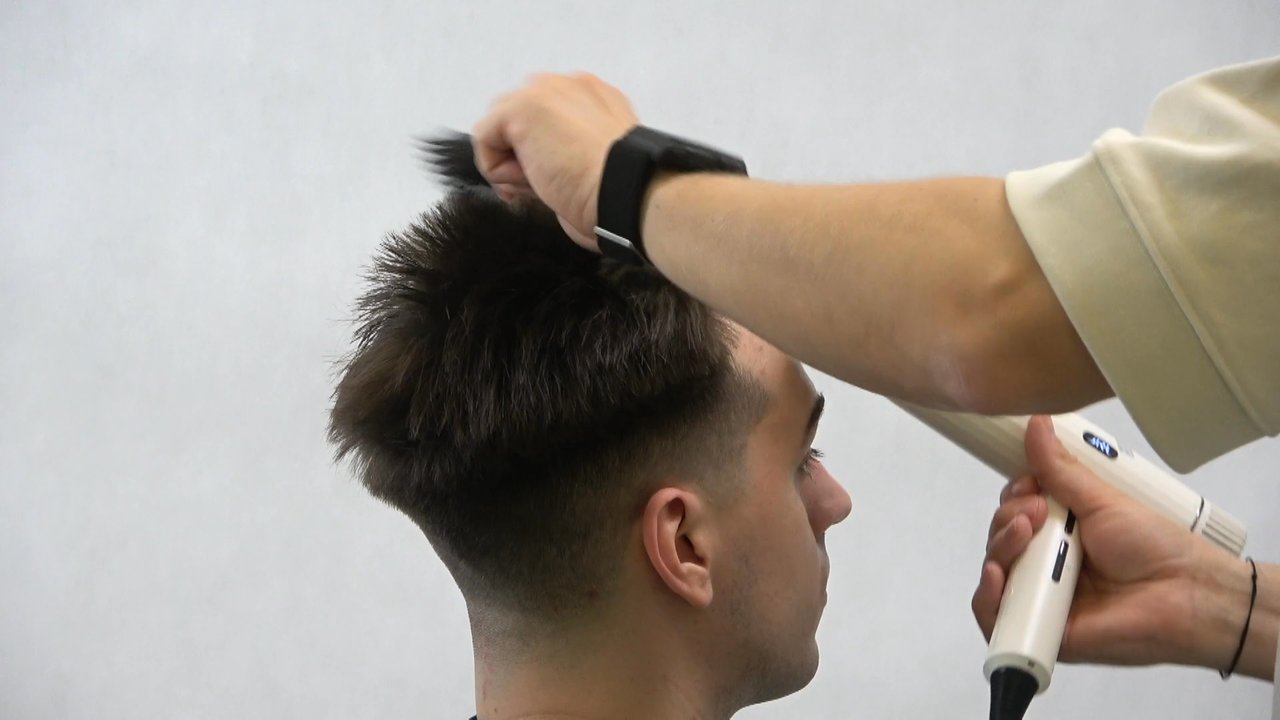
Styling: blow-dry from the forehead back over a round brush or your fingers, lifting the root. Finish with a medium-hold, matte paste or pomade, worked into the root — not just the ends. If a client doesn't want to style their hair daily, steer them away from a full quiff: this hairstyle lives on styling.
Tip: You can build your skills in volume and top shape work in the course “Volume and Shape Modeling in Men's Haircutting“.
Timothée Chalamet's Undone Look
What this hairstyle is about
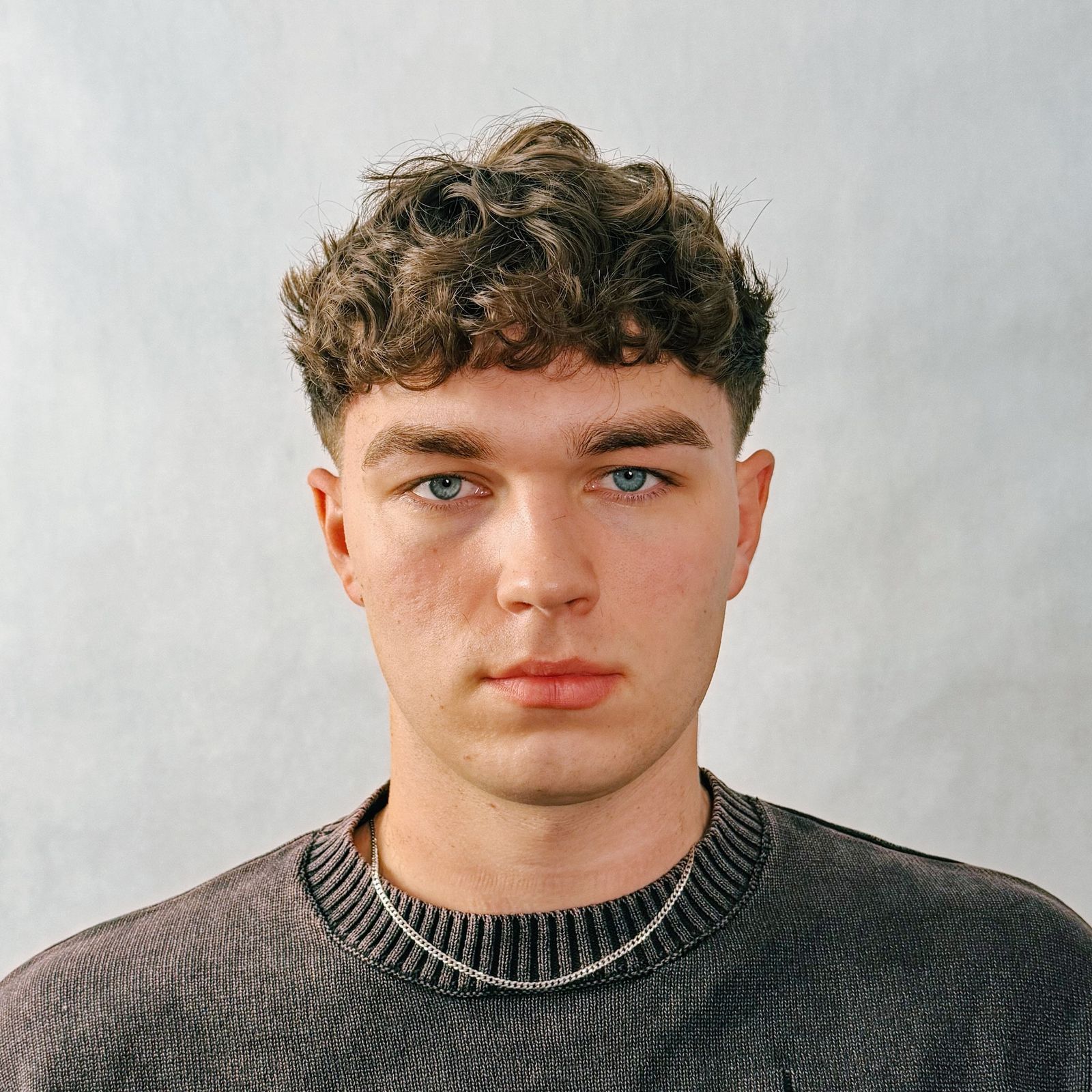
Chalamet's seemingly careless, wavy look actually demands more precision than a classic fade, because all the work happens in the texture and in how the hair falls. The sides and back are longer than in a typical men's haircut, the top has freedom and movement, and the fringe falls across the forehead in a wave, not a stiff curtain. The natural effect comes from removing weight, not from shortening length.
How to cut it
- Cut dry, following the hair's natural growth direction. Wet cutting is deceptive here: hair shortens and lifts as it dries, and you'll lose control over the fringe line.
- Work with scissors using point cutting and slide cutting, angling into the section. This breaks up the blunt edge and creates irregular, soft ends that add movement.
- Section horizontally and check length by lifting the sections at different angles. Low elevations preserve weight and length, higher elevations build layers and lightness at the crown.
- Leave the fringe noticeably longer and finish it softly so it falls in a wave. Avoid thinning shears over large areas: they thin the hair mid-length and create “holes” — you want lightness only at the ends.
Minimal styling: a light texturizing cream or sea-salt spray on damp hair, tousled with your fingers, dried without a brush. This hairstyle works on hair with a natural wave or dense straight hair; on thin, sparse hair it will fall flat.
Tip: You can practice control over layers and weight in the course “Square Layer Technique“.
Zayn Malik's Buzz Cut
What this hairstyle is about
The buzz cut is one length all over the head, cut with clippers, usually with or without a light fade on the sides. It looks like the simplest hairstyle in the shop, but that's exactly why it doesn't forgive mistakes: every unevenness, every change in growth direction, and every flaw in skull shape shows. Here, evenness and clean lines matter — not the amount of work.
How to cut it
- Set one clipper guard for the entire top and back (e.g., a shorter number for the final result) and always run the clippers against the grain, meaning opposite to the growth direction. This guarantees an even cut.
- Go multi-directional: pass over the same areas from several angles, because hair grows in different directions and a single pass will leave longer streaks.
- You can leave the sides at the same length or add a soft fade one or two guard numbers shorter to highlight the head shape. Blend the transition line so it doesn't leave a ring.
- Finish the line-up (beard line, sideburns, nape) with a trimmer or razor, sharp or soft, depending on whether the client wants a hard or natural finish.
Advisory note: a buzz cut exposes the skull shape and any scars or dents. If the client's head has noticeable irregularities or a receding hairline, suggest a slightly longer version on top to soften the proportions.
Tip: Learn a clean buzz cut technique — from the line-up to the fade — in the course “Buzzcut“.
Jason Momoa's Long Waves
What this hairstyle is about
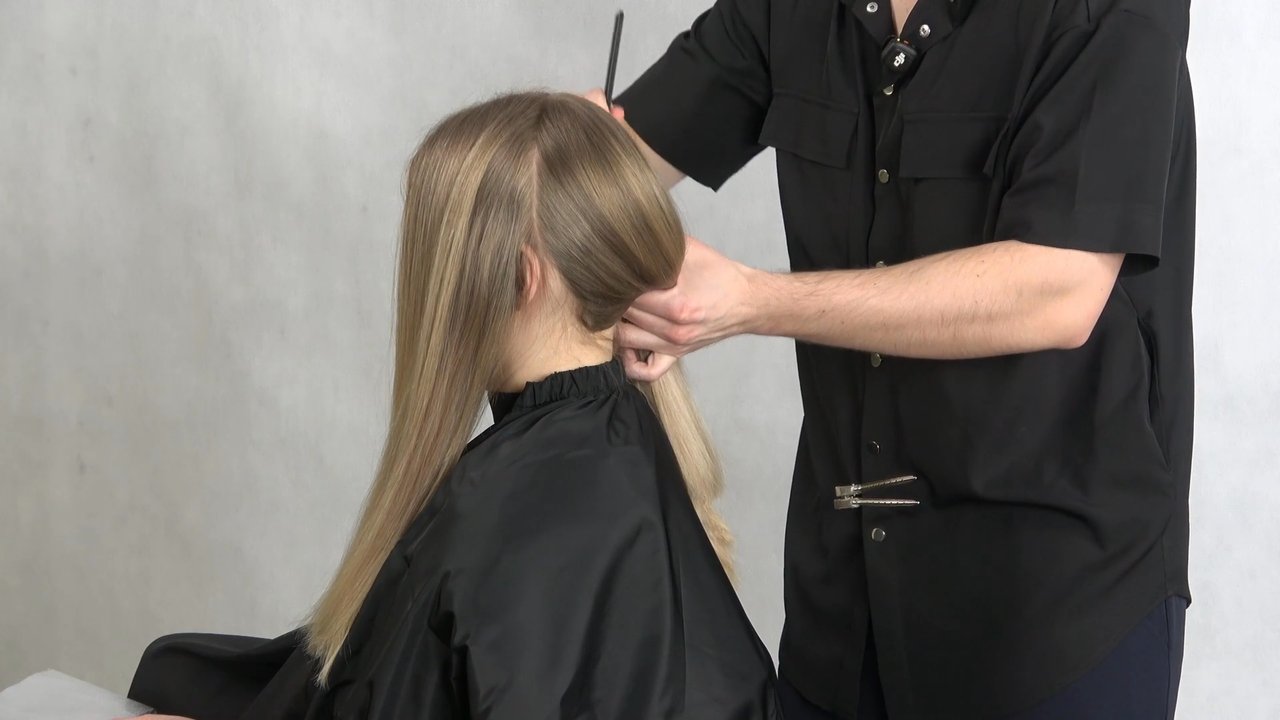
Long, wavy hair down to the shoulders or below is a different category of work than clipper cutting: what matters here is layering the long sections, preserving density at the ends, and controlling volume so the hairstyle doesn't spread out sideways. The longer the hair, the more important it is for the layers to blend smoothly and for the ends not to look chopped from a blunt cut.
How to cut it
- Plan long, connected layers: high elevation at the top removes weight from the crown and lets the wave settle, while lower elevation further down keeps the length and density the client doesn't want to lose.
- Finish the ends with slide cutting along the section, instead of cutting them bluntly flat. A blunt line on long hair looks blocky and stops the wave's movement.
- Cut the face-framing zone separately, fitting longer sections so they soften the features. These are what give this hairstyle its character in photos.
- With very dense hair, control volume with point thinning from the inside, never with thinning shears over the surface — that will pull out short regrowth hairs that will stick out.
This is a long-game hairstyle: warn the client that growing hair out to this length takes months, and the transitional stages require regular end trims so the hair doesn't lose its shape.
Fun fact: the trend for long men's hair dates back to antiquity. Read more about the history of men's hairstyles in the article “The History of Men's Hairdressing: From Antiquity to Today“.
Cillian Murphy's Textured Crop
What this hairstyle is about
The crop popularized by Cillian Murphy in “Peaky Blinders” is a short, textured top with a distinct fringe cut straight or slightly irregular, sitting above shortened, graduated sides. The vintage character comes from a high-contrast side and a sharp forehead line; the modern touch comes from texture on top, which breaks the stiffness and makes the hairstyle practical for everyday wear.
How to cut it
- Clip the sides and back with a fade, keeping the contrast at a medium height. The crop can handle a more noticeable length jump than the quiff, because the top is short and the contrast builds character.
- Leave the top short, but long enough to texturize: usually a few centimeters, with the longest point in the front zone.
- Cut the fringe as a distinct element. A straight, strong forehead line gives a sharp, classic look; irregular point cutting on the fringe's edge softens it and modernizes it.
- Work the top with point cutting all over to break up the compact mass and bring out texture. This is what sets a textured crop apart from a flat caesar cut.
Matte finish: clay or paste with strong hold and zero shine, patted into dry hair with your fingertips, without combing it smooth. A crop should look textured, not polished.
Tip: We break down the full crop-with-taper technique in the course “Crop with Taper“.
Ryan Gosling's Classic Side Part
What this hairstyle is about
The side part is a classic with a distinct side parting, a smoothly combed top, and controlled sides. Modern versions pair this elegance with a skin fade on the sides, which takes away some of the formal stiffness. The key is a clean, repeatable parting and a transition between the longer top and short sides that looks intentional.
How to cut it
- Leave the top long enough to comb smoothly to the side, with the greatest length at the front, tapering toward the back.
- Fade the sides: gentle for the formal version, or a skin fade down to the scalp for the modern version. The part usually falls along the hair's natural division line, which makes it easier for the client to recreate the hairstyle at home.
- With a skin fade, a hard part line is often carved in with a razor or trimmer. Cut it along the natural division line in one confident motion, parallel to the side you're combing the top toward.
- Blend the top into the side using comb-and-scissors work, so the smooth section doesn't cut off sharply above the fade.
Styling: a medium- or strong-hold pomade with shine on damp hair, combed to the side from the part. This is a hairstyle that never goes out of fashion and forgives a wide range of hair types.
Tip: Practice the side part with a skin fade and carved-in parting in the course “Side Part Skin Fade“.
Robert Pattinson's Artful Disarray
What this hairstyle is about
Pattinson wears hairstyles that look thrown together carelessly, but are actually carefully layered and styled. It's controlled chaos: layers of varying length, plenty of texture, and movement in every direction — all built on a precise distribution of weight. Without this foundation, the hairstyle doesn't look artistic, just neglected.
How to cut it
- Cut dry, following the natural growth direction, so you can see how the hair actually falls. This hairstyle comes from observing movement, not from wet geometry.
- Build layers of deliberately uneven length and break up every straight edge with point cutting and slide cutting. It's about irregularity that looks accidental but is actually planned.
- With curly hair, work on dry, natural curls and cut individual curls, not flattened sections. Wet cutting on curly hair is deceptive about length once it dries.
- Remove weight from the middle of the section, not from the surface, to preserve density at the perimeter and lightness inside.
Finish: a texturizing product with a light, matte hold, tousled loosely with your fingers. This look works on hair with texture or wave; on very straight, thin hair it's harder to maintain the volume this hairstyle depends on.
Tip: Develop your skills in curly texture work and controlled disarray in the course “Messy Curly Hair“.
How to Adapt a Celebrity Hairstyle to a Specific Client
A photo from the internet is a starting point, not a finished blueprint. The same hairstyle on a different face shape, different texture, and different hairline looks completely different. Your role is to translate the inspiration into a realistic, achievable result and tell the client plainly what will work and what won't.
- Read the face and head shape. A tall quiff elongates a long face, while a short crop with a fringe shortens and balances it; long sides soften a wide jaw. Match the top height and fade level to the proportions, not to the photo.
- Assess the hair type and texture. Dense, wavy hair will lift a quiff and carry the Chalamet look; thin, sparse hair will fall flat in them and holds up better as a crop or buzz cut. Also check growth directions and whorls before you promise anything.
- Ask about the hairline and hair age. With a receding hairline, avoid hairstyles with a full fringe forward, and build volume rather than exposing the forehead smoothly.
- Match it to lifestyle and willingness to style. A quiff and side part require daily work with a blow dryer and product; a buzz cut and crop forgive neglect. For a client who won't style their hair, give them a hairstyle that falls into place on its own.
- Suggest small steps for an undecided client. Instead of a radical change, shorten the sides and add texture on top, showing the direction without the risk of the client regretting the cut.
Tip: We break down how to have this conversation and advise clients in the article “How to Advise Clients on Choosing a Hairstyle: A Guide for Hairdressers“.
Celebrity Inspiration as a Working Tool
Celebrity hairstyles are a shared language with the client: a quick way to agree on direction, length, and character. But it's you who translates that photo into technique: where the fade falls, how much stays on top, what you finish the texture with, and whether the client's hair will even hold that shape at all. The better you can break down a well-known hairstyle into its craft, the more confidently you can match it to the person in your chair.
You'll find new cutting and finishing techniques on the blog and in our course offering.